Showing posts with label Energy Efficiency. Show all posts

Wednesday, March 20, 2013

TECHNOLOGY: Beyond Smart Home Security, Rise of Smart Appliances Coming in 2013


A new smart home appliance survey recalls a plot in a machines-take-over movie, but the new technology can actually help save the planet as well as energy costs.
about security issues, rather than gabby appliances telling them what to do.

More than half tech-savvy consumers told CEA they wanted to be remotely alerted to security problems and smoke detectors going off when they weren't at home.

They also said, at home and away, they wanted to be able to see who is at the front door and who enters or exits their home.

Terminating high utility costs
Apparently a similar number of households want to also juice up major appliances with smarts, according to Parks Associates, an international market research and consulting company specializing in emerging consumer technology products and services.
Park Associates said 44 percent of all U.S. broadband households would allow their power company to manage and monitor their home appliances to reduce energy consumption and save money.

They may just get their wish.
"Manufacturers are developing connected appliances to stay competitive in a mature market, where connectivity can differentiate products and add value through remote monitoring, enhanced functionality, and energy savings," said Tom Kerber, Director, Research, Home Controls and Energy, Parks Associates.

"Appliance manufacturers LG and Samsung have launched Wi-Fi-enabled appliances, and most major manufacturers are launching new connected products in 2013, which will continue to increase consumer awareness and strengthen the value proposition of connected appliances," Kerber added.

Manufacturers have already loaded appliances with sensors that do more than manage energy use; they also enhance control and convenience.

Smarter than consumers
For example, some washing machines "know" how much water to use for a given load of clothes. Clothes dryers shut down when they become "aware" the clothes are dry, even if the consumer has set the timer for a longer drying duration. Microwaves "sense" when a casserole has been zapped long enough.

Park Associates says households also want machines with smart troubleshooting features to help resolve appliance problems.

Perhaps, one day, they'll repair themselves.

The research and a recent energy summit, "The Role of Cloud-based Services and Connected Appliances in Energy Management," do however have an ominous "rise of the machines" ring to them.

Let's just hope this isn't the beginning of Skynet, the antagonist in the Terminator movie series - self-aware AI machines that ban together as war machines to replace humans.
But seriously, "The appeal of energy monitoring for appliances could be boosted by educating consumers about appliance energy consumption, which would ultimately provide more savings to consumers," Kerber said.

Thursday, December 20, 2012

ENERGY EFFICIENCY: Even higher heating bills in new forecast for winter

Figures exceed predictions made in October

Despite recent mild temperatures, colder days — and higher heating bills — are still on their way, according to a forecast released Tuesday by the federal government.

Heating oil consumers can expect to pay a record high average of $2,544 to warm their homes this winter, about $450 more than last year, according to an analysis by the Energy Information Administration.

Tuesday’s estimates were slightly higher than those released earlier in the season. In October, the agency predicted an average cost of $2,494 for the winter. Even a small increase, however, can have a significant effect in the Northeast, where 32 percent of households depend on oil heat, a considerably bigger proportion than elsewhere in the country.

Those who rely on natural gas — about 51 percent of Northeasterners — will pay an average of $1,031, close to $200 higher than last year. That estimate is about $20 higher than predicted in October, but overall prices have been falling as new sources of natural gas have become available in the ­United States.

Heating bills are expected to be that much higher because the government forecasts a more typical winter. Last year’s unusually warm weather kept thermostats lower, but this year the government expects consumption for heating oil and natural gas customers to increase by about 18 percent.

The rising cost of oil heat is of particular concern for low-income households that depend on federal fuel assistance to warm their homes. Applications are flooding in to the offices of Action for Boston Community Development Inc., an agency that administers heating aid in Boston and surrounding municipalities, said its president, John Drew. Last year, the group processed 18,000 applications; this year he expects to see as many as 24,000.

“We have an awful lot of people in need,” he said. “They’re more desperate than last year.”

And the aid they get may not be enough, he said. The maximum heating oil benefit this year will

Sunday, December 9, 2012

HOME MAINTENANCE: How to winter-proof your home

Winter can provide a much-needed respite from mowing and watering grass in sweltering summer temperatures and constantly swatting small, annoying insects. So now that the temperature is dropping, you might be planning to spend all of your free time on the sofa watching TV.

But don't pick up that remote just yet. There are six home improvement projects you really need to tackle in order to get ready for the winter. The good news? Unlike your grass - which requires constant mowing and watering - if you perform these winter projects now, you can relax on the sofa for years to come.

Must-Do Project #1: Replace Your Roof

Is your roof older than your college-age kids? If so, you may want to replace your roof now - while the weather isn't too harsh.
In fact, while you may have only minimal leaks or damage now, if you wait until the middle of winter, a severe snow or ice storm can exert enough pressure to cause the roof to collapse.
But how can you tell if your roof needs replacing?
Home improvement expert Jeanne Huber recommends replacing the roof if it's older than 20 years or if the majority of the roof has seen better days.

Huber, who writes a weekly home improvement column for The Washington Post, notes some early warning signs to observe:
  • Inside the house there may be water stains on the heater, damp areas around the fireplace, and dark spots on the ceiling; in addition, there may be peeling paint underneath the roof overhang.
  • Outside, look for buckled shingles, cracks in the caulk and rusted flashing, in addition to an accumulation of asphalt in the gutters. Also, the presence of moss may signal that the roof is decaying.
If Huber has just described your roof, it's time to consider replacing it.

Must-Do Project #2: Install Heated Floors

If you cringe at the thought of icy-cold feet during the winter, installing heated floors is a must-do project that will increase your comfort level and save on heating costs.
In fact, according to the National Association of Home Builder's (NAHB) article "LSC Members Provide Green Heating Choices for Energy-conscious Consumers," radiant floor heating

Wednesday, November 28, 2012

ENERGY EFFICIENCY: Programmable thermostats can save you money

Models can seve you money.

 Programmable thermostats can trim about $180 a year from your energy bills by automatically reducing heating and cooling needs when you’re away or asleep. Sounds simple, but not necessarily. While some of the 30 models Consumer Reports tested were easy to set and use, others were so complicated that you might give up in frustration and end up spending more, not less.

That’s pretty much what was happening across the country, which is why you won’t find the Energy Star on any thermostats. The program stopped certifying them in 2009 mostly because they were hard to use. New standards that factor in ease of use are being developed.

But you don’t have to wait. Consumer Reports’ testers rated ease of use based on how simple each thermostat was to set up and make routine adjustments to before reading the manual and then, if needed, with the manual. Most thermostats can keep rooms close to the chosen temperature, and all the thermostats rated have basic pre-programmed settings. Here’s what else Consumer Reports’ testing found:

Displays and prompts improve. 
The top three models have colorful interactive touchscreen displays that were especially easy to use and see. You can zip through the prompts on the top-rated Venstar ColorTouch, $170. The Honeywell Prestige $250, and the Ecobee, $300, let you program them using prompts or by answering questions about your daily habits. And if you get stuck at work, you can adjust the Ecobee’s settings, using your computer or smartphone, to turn the heat on later.

Smarter isn’t always better. 
The Nest, $250, is a learning thermostat. It continually senses whether you are at home and

Thursday, November 8, 2012

HOME PRODUCTS: Picking the right space heater

Various models can deliver warmth, but not necessarily savings

The best space heaters can quickly heat you and an average size room for as little as $40. Electric heaters tested by Consumer Reports include an array of safety features that reduce the risk of fire.

But that doesn’t mean all heaters are risk-free.


Many of the models tested got hot enough to cause the equivalent of a bad sunburn within a second of contact.

Almost all the hot spots are small and relatively hard to reach, though the one on the Sunbeam SQH310, $50, covers 112 square inches. There’s also a hot metal bar at the top that’s tempting to grab as a handle. The Sunbeam didn’t get hot enough to pose a fire risk, but it singed one of the terry-cloth lab towels used in the magazine’s fire-safety tests.


Consumer Reports tested 18 space heaters. Here are the details:

Dyson wins, but not in value. The fastest space heaters brought Consumer Reports’ 200-square-foot test chamber from a chilly 63° F to a comfy 70° F in 15 minutes or less. Consumer Reports also used a test dummy with heat sensors to see how quickly models would heat you and others if you were directly in front of them. Speedier spot heating helped Dyson’s AM04, $400, edge out the other top performers. But the Holmes HFH436, $40, did virtually as well and includes a start-up timer for preheating cold rooms.

Larger models offer mostly style. Paying more for the top-scoring larger space heaters buys a fancier wood casing. The $400 Heat Surge HT-XL has a fake-flame display and a cabinet the company touts as Amish-built. But like most heaters tested, its working parts hail from China. The Duraflame 10HM4126-0107, $230, performed similarly and trades the fake flames and Amish cachet for friendlier controls and a much lower price. But neither of those heaters performed better than the best smaller models.

Three were slow to heat. Larger heaters can also be slower at heating. Leisurely room and spot heating dinged the Soleus Air HM2-15R-32, $80, Consumer Reports tested and put the DeLonghi RD0715, $75, and wall-mounted Eco-Heater NA40045, $95, at the bottom of the ratings.

How to choose

Here’s what else to consider while shopping:

Choose the right type. Look for fast spot heating if you care more about quickly heating one or

Tuesday, October 30, 2012

HOME MAINTENANCE: 12 steps to winterize your home


The leaves are turning, the mornings are getting chilly, and winter isn't too far away. It's time once again for my annual checklist of important things that I recommend you do to get your home ready for the coming change of seasons.
On the inside
__ Check smoke detectors: Change your smoke detector batteries, and check for proper operation. Also, check the date on the bottom of the smoke detector. Smoke detectors have a life span, and if yours is more than 10 years old, it may not work properly in a fire, so replace it with a new one. Also, make sure you have a smoke detector at each sleeping room, and one centrally located on each level of the home.
__ Install a carbon monoxide detector: If you have a furnace, fireplace, water heater, or other appliance that's fueled by propane or natural gas, or if you have an attached garage, install a carbon monoxide detector. They just plug in, and you can get them inexpensively from most home centers and other retailers. If your existing carbon monoxide detector is more than 5 years old, replace it with a new one.
___ Check gas appliances: Speaking of gas appliances, consider having your utility company or heating contractor inspect flues, fittings, and other components of your natural gas or propane appliance and heating systems for potential problems.
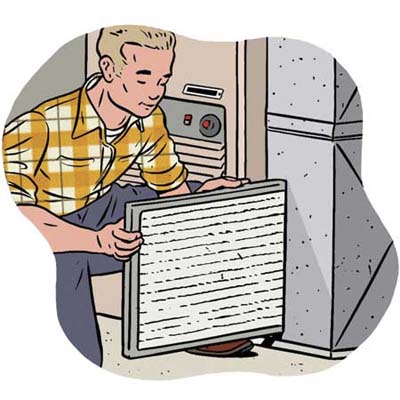
___ Change furnace filters: Always put in new furnace filters in the fall. It's a simple and inexpensive way to add to your home's efficiency and your family's comfort.
___ Check and seal heating ducts: Crawl a little, save a lot. Check the ducts in your attic, basement, and crawl space for gaps between ducts and fittings, and seal them with a quality metallic tape, not regular duct tape, which doesn't last. Also, check to be sure that all of the ducts are off the ground and adequately supported.
___ Check insulation levels: Increased insulation can make a huge difference in both your comfort and your heating bills, so don't put off having your insulation levels inspected. Call your local utility company or building department to learn what levels are optimum for your area. Check the attic, underfloor, kneewalls, skylight shafts and ductwork. Upgrade underinsulated areas as needed, either as a do-it-yourself project (home centers and hardware stores have all the supplies you need) or with the help of a licensed insulation contractor.
On the outside
___ Check the roof: A roof that leaks not only has the potential to cause significant structural damage, it also wets insulation, which causes a drop in the insulation's ability to resist heat loss. Examine roofing shingles and flashings, and repair or replace them as needed. It's much easier and safer to take care of these problems now than during winter's ice and rain.
___ Seal masonry surfaces: Apply a sealer to concrete driveways and walkways, brick patios and other exterior masonry. Masonry sealers prevent water from penetrating into cracks and crevices where it can freeze and cause serious damage. You can find sealers at home centers, paint stores and masonry supply retailers. Apply with a brush, roller or sprayer.
___ Check weatherstripping: Gaps around doors and windows waste expensive heated air and create chilling interior drafts. Check and replace or adjust weatherstripping and door sills to create an airtight seal. Everything you need can be found at home centers, hardware stores and many other retailers.
___ Handle yard chores: Many plants require pruning this time of year, and lawns should be

Monday, October 29, 2012

HOME HEATING: 10 essentials when buying, storing firewood


With rising fuel costs and wildfires in a lot of forested areas, whether you buy firewood or cut your own, you're almost sure to see an increase in the cost of the wood you burn this year. So whether that firewood is your primary source of heat or just cheery ambiance on a cold night, it pays to invest wisely and then protect your investment.
Buying firewood
If you buy firewood, there are a number of different sources where you can locate it. Many people turn to their local newspaper, Craigslist or maybe a community bulletin board. Other -- and sometimes more reliable -- sources of firewood include local tree-trimming services, fireplace shops, and retailers that sell and service chainsaws and related cutting equipment.
Firewood is sold by the cord, which is a stack of wood 4 feet high, 4 feet deep and 8 feet long (128 cubic feet). Firewood is obviously irregular in shape, so the stack also includes the air spaces between the pieces.
That's what a cord should look like in a perfect world. Ideally, the dealer you're buying the wood from will deliver it in a truck that makes verification of the load easy, such as a 4-by-8-foot truck bed, with wood stacked 4 feet high. That doesn't always happen, and you need to be careful when you see a truck roll up with wood tossed in the back: A sloping pile of firewood in a standard pickup truck may contain only 3/4 of a cord.
The other thing you'll be looking for when you buy your wood is whether it's dry, also sometimes called "seasoned," or whether it's "green." Dry firewood has been out in the air for a while since it was cut, allowing a significant amount of the wood's moisture to evaporate, typically down to a moisture content of around 20 percent or less. Green wood still has a lot of the moisture in it -- as much as 40 percent -- so when you burn it, the fire has to first evaporate that moisture. Therefore the wood burns cooler, and you get less heat energy per cord.
Visually inspect the wood that you buy. Dry wood feels light, has loose bark and darkened ends with clearly visible splits, and makes a very definite "thunking" noise when you hit two pieces together. Wet wood is just the opposite, and will sound dull and heavy when knocked together.
You'll typically pay a little more for dry wood, but it's worth the cost if you plan to burn it right away. If you're going to store the wood for burning next season, then you can save some money by buying green wood and letting it dry.
There are a couple of other ways to save some money when you buy your wood. If you have a truck or a trailer, you might be able to pick the wood up yourself at the dealer's lot and save delivery charges, and also verify your full cord at the same time. If you have wood delivered, there'll be an extra charge for stacking, so do that chore yourself if you can. Also, you can usually get firewood in full rounds, or pre-split. If you're ambitious, consider getting rounds -- they're cheaper, and you can get some great outdoor exercise by doing your own splitting.
Storing and seasoning the wood
Most people store a good portion of their wood supply outside where it can continue to dry and season, and keep a small portion nearby where it's accessible and ready for use.
Long-term storage areas should be located outside where wind and sun can help with the drying. However, to minimize danger in the event of a wildfire, and also to protect your home's siding in case the firewood contains any insects, the wood shouldn't be stacked directly against your house. Also, wood that's left out in the elements, even if it's dry, will reabsorb water from rain and snow, as well as from the ground. This will cause it to become too wet to burn efficiently, and eventually it will rot.
Ideally, consider creating an outdoor storage shed for your firewood, with a raised floor, a sloped roof for runoff, and open sides for easy access and unimpeded air circulation. Make it large enough to hold a year's worth of wood -- typically two to four cords, depending on your burning habits.
After the wood is dry, most people create a smaller storage area inside the house, such as in the garage or basement. Depending on your habits and the accessibility of your outside supply, the inside supply could be as small as two or three days' worth, or large enough to accommodate several weeks of wood.
Finally, create some storage right at the fireplace or wood stove. One very nice solution is a canvas carrying bag with enclosed ends and sides. The wood is stacked in the bag for carrying, then the bag hooks over a decorative metal frame near the fireplace for storage, containing the wood inside the bag to minimize the mess.
You might also consider a decorative metal tub or other container to hold one or two nights' worth of wood while keeping the dirt and chips contained. While not quite as neat, there are also a number of very attractive open metal storage racks offered by various manufacturers.
Any wood that you store inside needs to be far enough away from the fireplace that it can't combust. And most importantly, never store newspapers, kindling, pinecones or other easily combustible fire-starting materials next to your fireplace. They can and do start house fires!

Saturday, October 6, 2012

HOME MAINTENANCE: 5 must-do tasks for fall maintenance


Fall is here. That means beautiful trees, pumpkins, and that unmistakable smell that signals the end of summer and the soon-to-be winter months. 

Fall also means getting your home ready for the onslaught of winter. For those that live in the extreme southern portions of the country, winter might not be much different than other months. For people in most states, winter means snow and freezing, and that can cause expensive problems if people don't take the time and effort to get prepared during the fall months.
 Here are five basic home maintenance tasks to complete before the first snowfall.

Clear gutters
Once the leaves fall, do a final cleaning of your gutters and downspouts. Clogged gutters makes runoff from snow freeze within the gutters. This is especially true for older gutter systems, and it may lead to the gutters separating from your roof. This not only causes damage to your gutters, but also to the underlying structure of the roof that holds the gutter. If you don't like cleaning out your gutters, invest in gutter guards.

Do an energy audit
Do you know where your heat and air conditioning is escaping? An energy audit is the way to find out. Although you can pay private contractors to perform the audit, your gas or electric company might send somebody to your home free of charge. Depending on the age of your home, sealing areas where the heat or air conditioning is escaping can result in substantial savings over time. Even the smallest leaks add up over time. You can also do this yourself by examining for cracks in doors and windows and looking for any areas where you can see daylight coming through. The audit will check other areas like electrical and cable outlets on outside walls.


Trim trees
Have your trees trimmed every few years to assure that accumulated ice doesn't cause a dead branch to fall on to your roof. Once the leaves fall and you can see the branches of your trees, look for any larger-sized branches that appear dead and would fall onto yours or your neighbor's roof. If you knew the limb was dead and it damaged a neighbor's home, your homeowners insurance may not cover the damages.

Test your home generator
If you live in an area with extreme weather or have medical or other essential devices that require electricity, investing in a home generator might be wise. If you have one, test it, along

Friday, September 7, 2012

TECHNOLOGY: Is it worth paying for super-fast Internet in your home?

Rapid advances in technology over the last few years have made a broadband connection essential for many of us in our daily lives. Streaming more HD movies, downloading music, and using data-heavy video chat services like Skype and FaceTime can make basic broadband speeds seem a bit sluggish.

Luckily, you do have some options to choose from. We've taken a look at three of the larger broadband providers in the country -- Comcast, Time Warner Cable, and Verizon -- to show you some options if you would like to dramatically increase your Internet speeds.

How fast is my broadband now?

(Photo: Tyler Olson/Shutterstock)The average speed that Americans get from their home Internet service is 5.8 megabits per second (Mbps). Those numbers may seem decent, but those speeds place the United States in 13th place worldwide, behind countries like Latvia, the Czech Republic, and Romania. Even the city with the fastest Internet service in America, Boston, only averages 8.4Mbps -- speeds that wouldn't place it in the top 50 cities worldwide.

America's slow broadband speeds aren't due to lack of availability but a lack of knowledge among cable companies' customers. Cable companies push low-end broadband packages, because they are usually cheaper -- and much slower. For instance, most Verizon customers don't have a clue that Verizon offered broadband with speeds of 300Mbps on June 17 -- the fastest broadband connection in the country, fast enough to download a two-hour HD movie in under two minutes.

What are my high-speed options?

Aside from Verizon's world-class offering (which costs $204 a month), there are other extremely fast options from Comcast, Time Warner Cable, and Verizon.

Coming in right behind Verizon's highest broadband package is a 150Mbps offering that costs $94 a month. Another option is an $84-a-month plan that will get you speeds of 75Mbps. Be aware of the hidden costs with Verizon; all of these prices are contingent upon a two-year contract (if you don't sign, the price goes up $5 a month, plus you have to pay a $100 equipment fee) as well as Verizon's home phone service (another $5-a-month surcharge if you don't have it).

Time Warner Cable also has faster options for you, but they are nowhere near what Verizon is offering. Time Warner's highest offering is $79 a month, which gets you speeds of 50Mbps for your home Internet needs. For $49 and $39 a month, you can get speeds of 30Mbps and 20Mbps, respectively. All of these prices are promotional and will rise after the first year.

(Photo: iStock)Comcast does offer higher speeds than Time Warner Cable, but it comes at a premium. At 105Mbps, Comcast's fastest option comes in at $199 a month, $5 cheaper than Verizon's highest option, which offers speeds

Saturday, August 4, 2012

BOSTON HOUSING NEWS: Boston, developers betting tiny Seaport apartments will be a big thing


A small platform, painted black with images of kitchen appliances and living room furniture outlined in bright neon, was celebrated Thursday as the future of housing in Boston’s fast-growing Seaport District.
The platform, with a faux wall on one side, was a mock-up of the ultrasmall apartments under construction at the Seaport’s newest residential building, the Boston Wharf Tower on A Street. With units as small as 450 square feet, the apartments fit Mayor Thomas M. Menino’s call for more affordable housing in the district for young professionals who want to live near work and social attractions.
“From the very start of our plan for the waterfront and Fort Point Channel, we knew housing would be a crucial part of the equation,” Menino said Thursday during a ceremonial ground-breaking at that $100 million Boston Wharf Tower. “This project will help turn this neighborhood

Sunday, July 15, 2012

NEWS: Wind farms on land grow with few critics

Despite controversy that has slowed the Cape Wind project in Nantucket Sound, land-based wind farms are expanding rapidly in the region.
 
One company alone, First Wind Holdings LLC of Boston, has installed enough turbines in the Northeast over the past few years to generate nearly as much power as the long-awaited offshore wind farm. Other companies, too, have developed wind projects in New England states.

Driving this growth are technological advances reducing the cost of wind turbines and increasing their efficiency, making wind power more competitive with traditional power sources — particularly in the Northeast, where electricity costs can run as much as 60 percent above the national average.

Turbine prices have dropped about 30 percent over the past few years, and new turbines are able to generate electricity at lower wind speeds.

Meanwhile, average electricity prices in the Northeast can top 15 cents per kilowatt hour, compared to a US average of 9.52 cents. New wind technology can generate power at an average cost of about 10 cents per kilowatt hour, excluding subsidies, according to the US Energy Department.

“Some of the states in the Northeast have been some of the fastest-growing markets,” said Elizabeth Salerno, director of industry data and analysis at the American Wind Energy Association, a trade group in Washington. “Power prices are relatively high [there], so by delivering wind projects, you can develop a pretty affordable source of generation.”
First Wind has built wind farms in eight locations in Maine, Vermont, and upstate New York. With the 34 megawatts that will be added when the company completes its wind farm near Eastbrook, Maine, First Wind’s projects will have the capacity to generate nearly 420 megawatts of electricity, compared to Cape Wind’s 468 megawatts.

In addition, Quincy-based Patriot Renewable operates two wind farms in Maine and one in Buzzards Bay, with a total generating capacity of about 25 megawatts. The Berkshire Wind Power Cooperative Corp., a consortium of 14 municipal utilities and the Massachusetts Municipal Wholesale Electric Co., owns a 15-megawatt wind farm in Hancock that went online last year.

A megawatt of wind-generated electricity can power about 300 homes.

Despite the growth of land-based projects, the discussion about developing the region’s wind resources has often focused on offshore projects such as Cape Wind and a proposed “wind energy area” that would encompass nearly 165,000 acres of federal waters off the coasts of Massachusetts and Rhode Island. Last week, US officials completed an environmental review of the wind energy area, an important step in opening the area to development.

Still, it could be years before any turbines are built offshore, meaning that more land-based projects will be needed to achieve renewable energy goals set by several states seeking alternatives to fossil fuels, such as oil, coal, and natural gas. In Massachusetts, for example, the state has set a goal of installing 2,000 megawatts of wind-energy capacity in the state by 2020 and has required utilities to get 15 percent of their power from wind, solar, and other renewable sources in that same time frame.

Today, there are 61 megawatts of installed wind power capacity in the state.
This has created opportunities for companies like First Wind. Founded a decade ago, the

Thursday, June 21, 2012

HOME IMPROVEMENTS: Forget Cost Vs. Value, Homeowners Use Improvements To Pump Up Style, Not Equity


Sure, most home improvements will hold or boost equity, even in the worst market, but today's homeowners are more concerned that improvements enhance their home's form and function rather than its value.

Homeowners also say rather than cut into their
 home improvementbudget, they are more likely to slash expenses in other areas including vacations and other big-ticket purchases, in another example of an emerging trend that finds beleaguered homeowners hunkering down to hold onto their most valuable asset by making it more their own.A new survey of homeowners planning to build, remodel or decorate in the next two years, found the vast majority, 86 percent, saying it's more important to improve their home to "improve the look and feel of the space," compared to 47 percent who say it important the work increases their home's value.

The Houzz & Home Survey, which comes with a really cool infographic of the results, analyzes remodeling and decorating project histories and plans of Houzz users in the U.S. and Canada.
The survey also examined motivations behind the projects, homeowners’ plans for hiring remodeling and design professionals or doing it themselves, and how the economy plays a role in decorating and remodeling plans.

"We expected that in this economy Americans' highest priority would be increasing home value, but instead we found people are focused on pleasing themselves, not the next owner," said Liza Hausman, vice president of marketing for Houzz.

"Homes today are doing double or even triple duty as workplace, stay-cation, gym and more," Hausman added.

Many don't have an option, according to a recent National Association of the Remodeling Industry (NARI) survey of homeowners forced to stay in their homes years longer than they originally expected because the economy ruined their plans.

NARI found, instead of sulking about their house arrest, long timers have begun to turn their cells into cozy personalized nests - homes that better reflect individual lifestyles to make them

Friday, June 8, 2012

HOME MAINTENANCE: Air Conditioning: 9 Things You Need To Know

Ah, the sweet relief of a cool, dry house after a hot, sweaty afternoon of yard work. Like any mechanical system, AC needs a little TLC to run smoothly, including many tasks you can tackle on your own. 
 
We asked This Old House plumbing and heating expert Richard Trethewey to share his know how for central air and window units. Read more here.