Showing posts with label Selling Your Home. Show all posts

Saturday, March 23, 2013

SELLING YOUR HOME: Patio Appeal May Add Value To Your Home


Depending on where you live, a patio might not be the kind of thing you think about during the cold, and maybe snowy, winter months. But a patio is what many people enjoy on a sunny warm afternoon. It just feels good to sit outside and sip some iced tea or lemonade. That's the picture your real estate agent would want to capture when listing your home for sale.


Patios are appealing because they can create a sense of peace, open space, freedom, and they can seem to extend the square footage of livable space on those good weather days.

Set out on your patio some simple but comfortable patio furniture when you're listing your home and you might find that prospective buyers take a seat and think about your home. Good! Let them soak in the energy of the home. The way it feels. The way it allows them to relax. Set some brochures out on a side table. Maybe even a good book. You'd be surprised what these buyers pick up. If they enjoy themselves while sitting on your patio, you're likely to have piqued their interest in your property.

So, what if you have a backyard but no patio; is it worth investing in one? The answer depends on your financial situation but there's no doubt that having a patio or a deck - a space outdoors to relax - is a plus.

Thursday, March 21, 2013

SELLING YOUR HOME: Find the Best Agent to Sell Your House


Ask detailed questions about their experience and skills to help you find the right agent for your home sale.

1. How long have you been selling homes?

Mastering real estate requires on-the-job experience. The more experience agents have, the more likely they’ll be able to handle any curveballs thrown during your home sale.

2. What designations do you hold?

Designations like GRI (Graduate REALTOR® Institute) and CRS® (Certified Residential Specialist), which require that agents complete additional real estate training, show they’re constantly learning. Ask if agents have designations and, if not, why not?

3. How many homes did you sell last year?

Agents may tout their company’s success. An equally important question is how many homes they’ve personally sold in the past year; it’s an indicator of how active and aggressive they are.

4. How many days on average did it take you to sell homes?

Ask agents to show you this data along with stats from their local Multiple Listing Service (MLS) so you can see how many days, on average, their listings were on the market compared to the average for all properties in the MLS.

5. How close were the asking and sales prices of the homes you sold?

Sometimes sellers choose their agent because the agent’s suggested listing price is higher than those suggested by other agents. A better factor is the difference between listing prices and the amount homes actually sold for. That can help you judge agents’ skill at accurately pricing homes and marketing to the right buyers. It can also help you weed out agents trying to dazzle you with a lofty sales price just to get your listing.

6. How will you market my home?

The days of agents putting a For Sale sign in the yard and hoping for the best are long gone.

Sunday, March 10, 2013

MARKET TRENDS: Real estate markets strengthen


Nearly all twelve Federal Reserve districts reported modest to moderate growth in economic activity in the Fed's latest February Beige Book.
Residential real estate markets posted the strongest results, with impressive growth throughout nearly all the districts as home prices rose amid falling inventories across the country, the report said.
The Boston, Dallas, Kansas City, Minneapolis, San Francisco and St. Louis districts reported slight improvements.
Meanwhile, Philadelphia real estate continued to report low-end home prices as firm or rising or increasing slightly, while high-end home prices continued to fall.
Inventories also declined in nearly all districts, with Realtors in several districts concerned about the impact on future sales volume, the report noted.
Home construction increased in most districts, with the exception of the Kansas City District where it was reported as unchanged.
Additionally, several districts noted ongoing strength in multifamily construction. However, the Atlanta and Cleveland districts reported continued financing difficulties for builders.
Overall commercial real estate conditions were mixed or slightly improved in most districts, the

Saturday, March 9, 2013

MARKET TRENDS: Home prices finally returning to normal

After years of wild swings, the U.S. housing market is slowly returning to normal.

The latest forecast from Fiserv (FISV) Case-Shiller predicts home prices will increase by an average of 3.3% annually over the five years ending September, 2017.

"2012 was the first year since 1997 that the housing market has resembled something [close to] normal," said David Stiff, Fiserv's chief economist. "For the past 15 years, home price changes and sales volumes have either been boosted by a bubble mentality or crushed by crash psychology."

From 1998 until the housing bubble peaked in 2006, home prices grew by 5% or more a year. But once the bubble burst, home prices plunged, falling 30.5% through the end of September 2012.

It wasn't until late 2011 that markets started to stabilize, according to Stiff. Between September 2011 and September 2012, average U.S. home prices rose 3.6%. By then, 62% of the 384 metro areas Fiserv tracks reported rising home prices, up from just 12.5% of all markets during the same period a year earlier.

Many of the metro areas hit hardest by the housing bust recorded the biggest price gains

Tuesday, March 5, 2013

SELLING YOUR HOME: Top 5 Mistakes Home Sellers Make


THE REAL ESTATE market may be in the doldrums, but that doesn't mean it's impossible to sell your home. Sellers just need to be savvy and not fall prey to common mistakes. Here are five missteps home sellers should avoid:
1. Asking Too Much
The single biggest mistake folks make is setting their asking price too high. In today's down market homeowners need to price conservatively or they risk turning off potential buyers, says Michael Corbett, author of "Ready, Set, Sold."
Figuring out how to set the price is tricky. Gone are the days when you can expect to sell your home for as much as your neighbor did just six months ago, according to the National Association of Realtors. So rather than looking at how much homes in your area sold for six to 12 months ago, compare prices for similar properties currently on the market. If you see a listing for a house that's sitting unsold for a few months, chances are the owners are asking too much and you'll want to set your price lower, says Corbett.
Watch our video for more advice on setting the right price.
2. Questioning the First Offer
Read our story here
The reality is that in any market a home's first offer is often its best, says Elaine Clayman, a real estate broker with Brown Harris Stevens. Typically, educated buyers will seize on a property they like with a competitive bid as soon as it comes onto the market, she says. Of course, given the glut of houses on the market, sellers should expect to receive some low-ball offers. Just don't assume that you'll get better bids the longer you hold out. As Clayman warns, the more time a home sits unsold, the greater chance a seller will have to reduce his price.
3. Failing to Respond to All Offers
What if you get an offer that's simply too low? Don't reject it outright. See if you can negotiate. First of all, you can't blame someone for testing the market after all, in today's market, many buyers are confident that they have the upper hand. Secondly, by entering into negotiations with one party, you'll gain leverage with other potential buyers, says Corbett. Most importantly, it allows you to tell brokers that your property is in play and sends a message that if someone is interested, then he better present a competitive bid quickly.
Just don't get cocky. During this process, it's crucial for sellers to set a realistic bottom-line price they're willing to take, even if it's several thousand dollars below asking, says Corbett.
Watch our video for more advice on negotiating.
4. Paying for a Home Stager
In a depressed market, it's more important than ever that your property stands out from the competition. But unless you're trying to sell a multimillion-dollar mansion, you don't need to pay a professional to stage your home. There are a number of free or inexpensive things you can do on your own to get your house into show condition. Most importantly, paint the walls. Nothing does more to brighten up a place, says Peter Comitini, a real estate broker with Corcoran Group. Next, he recommends getting rid of all the clutter, excess furniture and family knickknacks. Finally, make all the necessary repairs before your first open house. If a buyer sees a small problem, say, a leaky faucet, he's likely to wonder about larger issues like the furnace or roof.
Read our story here for more home improvements that pay off. Or watch our videofor more techniques on how to stage your home.
5. Picking the Wrong Buyer
Now more than ever, sellers need to select their buyers carefully. As we mentioned earlier, thanks to all the defaults in the subprime market, lenders are tightening their lending practices, making it more difficult for consumers to qualify for mortgages. So it's critical to find a buyer with a recent prequalification letter (issued no later than four to six weeks ago) for a loan.
Next, watch out for buyers who need to add contingencies to the contract, including a clause stating that the deal won't close until they sell their own home. A better bet is to look for cash-flush first-time home buyers or someone who has already unloaded his existing house. In a slowing market it's difficult to estimate how long it could take your buyer to find someone to purchase his dwelling, warns Brown Harris Stevens' Clayman. And if that property doesn't go for as much as he expected, that person may no longer be able to afford your agreed-upon price.This story was originally published on AOL on May 19, 2008.

Saturday, March 2, 2013

SELLING YOUR HOME: 5 Reason you should List your home Now


Many homeowners are waiting until the Spring ‘buying season’ to list their homes for saleHere are five reasons why that might not make sense this year:

1.) Demand Is High

Homes are selling at a pace not seen since 2007. The most recent Existing Home Sales Report by the National Association of Realtors (NAR) showed that annual sales in 2012 increased 9.2% over 2011. There are buyers out there right now and they are serious about purchasing.

2.) Supply Is Low

The monthly supply of houses for sale is at its lowest point (4.4 months) since May of 2005. The current month’s supply is down 21.6% from the same time last year. Historically, inventory increases dramatically in the spring. Selling now when demand is high and supply is low may garner you your best price.

3.) New Construction Is Coming Back

Over the last several years, most homeowners selling their home did not have to compete with a new construction project around the block. As the market is recovering, more and more builders are jumping back in. These ‘shiny’ new homes will again become competition as they are an attractive alternative to many purchasers.

4.) Interest Rates Are Projected to Inch Up

The Mortgage Bankers’ Association has projected mortgage interest rates will inch up approximately one full point in 2013. Whether you are moving up or moving down, your housing expense will be more a year from now if a mortgage is necessary to purchase your next home.

5.) Timelines Will Be Shorter

The dramatic increase in transactions caused many challenges to the process of buying or selling a home in 2012. We waited for inspections, dealt with last minute appraisals and prayed that the bank didn’t ask for ‘just one more piece of paper’ before issuing a commitment on the mortgage. There are fewer transactions this time of year. That means that timetables on each component of the home buying process will be friendlier for those involved in transactions over the next 90 days.

Wednesday, February 27, 2013

SELLING YOUR HOME: Is There a Window of Opportunity for Sellers Right Now?


One of the most interesting revelations of the latestNational Association of Realtors (NAR) Existing Home Sales Report is the shortage of housing inventory being reported throughout much of the country. At the same time, buyer demand is dramatically up over last year.  Here are some key points:
  • Total housing inventory at the end of January fell 4.9 percent to 1.74 million existing homes available for sale, which represents a 4.2-month supply at the current sales pace.
  • This represents the lowest housing supply since April 2005 when it was also 4.2 months.
  • Listed inventory is 25.3 percent below a year ago when there was a 6.2-month supply.
  • Raw unsold inventory is at the lowest level since December 1999 when there were 1.71 million homes on the market.

What Does This Mean if You Are Selling a Home?

The price of anything is determined by supply and demand. According to NAR’s report, inventory is at its lowest level since the real estate boom eight years ago. At the same time, demand is up. Lawrence Yun, NAR chief economist, reveals:
“Buyer traffic is continuing to pick up, while seller traffic is holding steady. In fact, buyer traffic is 40 percent above a year ago, so there is plenty of demand but insufficient inventory to improve sales more strongly. We’ve transitioned into a seller’s market in much of the country.”
Does that mean you should sell your house now? Or should you wait to see if prices increase? Nobody knows for sure. However, some feel that there may be a pent-up inventory about to come to the market because, as prices increase, it will free up some sellers who have been locked in a negative equity situation (where the house is worth less than the remaining mortgage).
The Zillow Negative Equity Forecast predicts: 
“The negative equity rate among all homeowners with a mortgage will fall to at least 25.5

Monday, February 25, 2013

MARKET TRENDS: Six Reasons Housing Inventory Keeps Declining


Home sales in December dropped by 1% from November, the National Association of Realtors reported on Tuesday, but still stood nearly 13% above the levels of one year ago. That means home sales have risen from the year-ago month for 18 straight months.
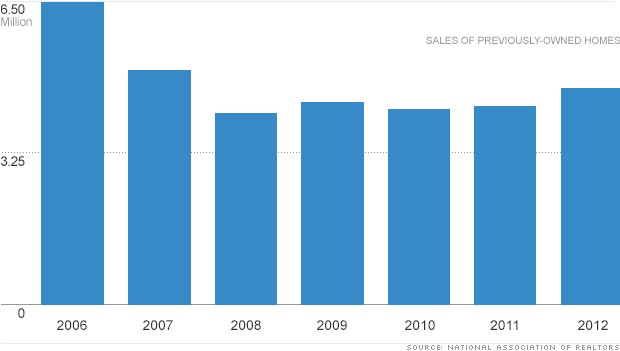
For 2012 as a whole, sales were up 9% to 4.65 million units, the highest annual total since 2007.
Prices, meanwhile, are picking up because the number of homes for sale continues to drop despite the sales volume gains. The number of homes for sale fell to 1.82 million at the end of 2012, an 8.5% drop from November and a 21.6% decline from one year earlier, the Realtors’ group said on Tuesday.
Here’s a breakdown of why inventory has continued to drop this year:
Many homeowners are underwater: More than 10 million homeowners owe more on their mortgage than their homes are worth, according to CoreLogic Inc. CLGX +0.61% That pencils out to around 22% of homeowners with a mortgage, or 15% of all homeowners (since not every homeowner has a mortgage). Underwater owners aren’t likely to sell unless they need to move due to changing life (marriage, divorce) or financial circumstances, and they’ll take a hit on their credit for pursuing a short sale, where the bank allows the home to sell for less than the amount owed.Data from CoreLogic show that inventory has been the most constrained in housing markets where there’s the largest concentration of underwater borrowers.
Others don’t have enough equity to “trade up”: Another 10 million homeowners have less than 20% equity in their current residence, meaning they can’t easily “trade up” to their

Saturday, February 23, 2013

BUYING A HOME: Seasonal Flip-Flop Hallmarks Housing Recovery, Tough Times For First-Time Buyers


Just as home price gains are moving up against the traditional seasonal grain, inventories are going down at a time when they typically turn up.

A new report by Movoto.comreveals the housing inventory is down to its lowest point in three years.And that's bad news for homebuyers, especially first-timerstrying to take the plunge.
Across Movoto's 34-city tracking area, inventories of homes for sale in January dropped to 88,000, down 19 percent from December and 47 percent off the 2010 peak.

Meanwhile the monthly list price per square foot increased from $169 in December to $173 in January, $155 a year ago and $162 two years ago.
By Movoto's measure, homes on the market today are more expensive they they've been for the past two years.

Graphs by Movoto Real Estate

Among the top 10 major metros with the greatest year-over-year drop in inventories, 7 are in California.

The top 10 cities in Movoto's coverage area with the greatest decline in homes for sale, along with the decline by percentage, are:
Sacramento - 75.11 percent
Oakland - 66.77 percent
San Francisco - 61.41 percent
Long Beach - 56.19 percent
San Diego - 49.34 percent
Los Angeles - 48.68 percent
Fresno - 47.62 percent
Portland - 43.18 percent
Denver - 39.02 percent
Houston - 35.02 percent

Movoto says inventories are inadequate for a host of reasons and those reasons are squeezing first-time home buyers out of the market.

• Equity is on empty - With insufficient equity to sell homes at a profit, homeowners are sitting tight. Only those who are struggling and unable to get a workout are forced to sell - at a loss. Until the market returns sufficient equity to these homeowners, they are going nowhere fast.

• Catch 22 - Homeowners who can sell at a profit are afraid they won't be able to purchase a decent move-up, -over, or -down home.

"Remember standing around at the high school dance wondering who's going to be first to ask

Monday, February 11, 2013

MARKET TRENDS: Impacts Of The Improving Housing Market

A lot of people are clamoring about the improving housing market. Many wonder if we have really turned the corner and how much better it will get. Also, what impact will it make?

Chief economist, Anthony Chan, for private wealth management at J.P. Morgan in New York, as reported by Business Observer, said, "Things are getting better because housing is getting better."

The rising housing prices ignite a sense of confidence in the economy and lead to greater spending. What this means is that there is great opportunity for sellers.

One group in particular is the "boomerang buyers". That's the term being used for those homeowners who lost their home to a short sale or foreclosure in the recent past and now are shopping for another home to buy.

However, the guidelines for these buyers are strict. It's likely they have to have at least 20 percent deposit and wait at least two years after the foreclosure before they can buy again. It's unlikely that high-risk loans will be available to this group.

Sellers are noting the improving housing market and anticipating an even better year. Part of that is not only due to rising home prices but also less inventory. In December, 1.82 million homes were listed for sale according to the National Association of Realtors, down 22 percent from a year ago. The supply hasn't been this low since 2005.

This may seem like all good news, at least for sellers, but if home prices rise due to a

Saturday, February 9, 2013

MARKET TRENDS:L Prices are up, but homes are in short supply


The supply of homes for sale has been shrinking for six months and shows no improvement so far in January — a bad sign for buyers.
Listings of existing homes for sale were down 14% year-over-year in the first two weeks of January, according to Realtor.com, which tracks 146 markets nationwide.
In Phoenix, where prices were up 24% in November from a year earlier, new listings through the first three weeks of January hit their lowest level in 13 years, says Mike Orr, real estate expert at the W.P. Carey School of Business at Arizona State University.
That's bad news for buyers, and it means "prices need to go up more" to bring more sellers to market, Orr says.
Nationwide, the supply of existing homes for sale fell to 4.4 months in December, based on the current monthly sales pace, says the National Association of Realtors. That's the lowest level in more than seven years. A six-month supply is generally considered balanced between buyers and sellers.
Home prices in November were 7.4% higher on average than a year earlier, according to CoreLogic. Real estate experts had expected that rising prices would spur more sellers trapped by years of falling prices.
Instead, January's listing data "is the same sad story," says Glenn Kelman, CEO of online brokerage Redfin. If sellers don't have to sell, "they're holding on, thinking they'll wait for prices to go up even more."
Redfin's data, covering 19 major markets mostly in the West, shows new listings down 29% the first two weeks of January vs. last year.
Scarce sellers aren't the only driver of shrinking supplies. There are fewer distressed properties for sale. Foreclosure sales were down 7% through the first nine months of last year from the same period in 2011, RealtyTrac says.
Meanwhile, demand is up. Existing home sales were up 9.2% last year, NAR's preliminary data show. New-home sales rose almost 20% in 2012, the government

Wednesday, February 6, 2013

MARKET TRENDS: Housing market strengthening in US, around Boston


Home values in the Boston area rose by 2.3 percent in November compared with the same month in 2011, according to data released Tuesday by the S&P/Case-Shiller Home Price Indices, which is widely considered a reliable measure of the housing market.
Nationwide, the improvement was more pronounced, with prices increasing by 5.5 percent in the 20 metropolitan areas tracked by Case-Shiller. Unlike some other housing barometers, the index is based on repeat home sales, which many industry analysts consider a more accurate way to gauge the market.
The numbers add to a growing bundle of economic news showing the country’s long-suffering housing industry is on the rebound.
David M. Blitzer, chairman of the index committee at the S&P Dow Jones Indices, said the increase in sales and values provides further evidence the housing market is helping to jump-start the US economy.
But Blizter cautioned US home values are not likely to continue to rise at such a brisk pace. Normally, he said, values rise a bit faster than the rate of inflation.
“We are on the rebound and at some point the rise in prices will flatten out a little bit,” he

Monday, February 4, 2013

MARKET TRENDS: 2012 home sales: Best in 5 years

Steady December home sales capped the best year for the U.S. real estate market in five years, according to an industry trade group report Tuesday.


The National Association of Realtors said that December sales of previously-owned homes came in just slightly below November's sales pace, but up 12.8% from a year ago. That brought full-year sales to 4.65 million, up 9% from 2011 and the best year for home sales since 2007, when there were 5 million homes sold just before the start of the recession.

Sales are being helped by a combination of strong market fundamentals -- near record low mortgage rates, lower unemployment and a rebound in home prices, all of which are bringing in buyers into the market who had been waiting for it to hit bottom. The mortgage rates and years of depressed home prices have also combined to create the most affordable housing market on record, according to the Realtors group.
And the Realtors are predicting strong sales should continue into 2013 and beyond. It has a

Friday, February 1, 2013

MARKET TRENDS: U.S. home prices crawl upward


U.S. home prices continued to inch their way up, showing a 0.5% increase from October to November, according to the latest Lender Processing Services home price index.
Home prices grew 5.1% year-over-year, based on LPS’s analysis of homes in 15,500 ZIP codes.
The LPS HPI is a study of non-distressed home sales and discounts the influence of REO sales and short-sale transactions.
The average price for a home sold in the U.S. in November reached $207,000, dropping from a peak of $266,000 in June 2006, but up from $197,000 in November 2011.
The states that saw the greatest price appreciation in the report were Florida (prices up 1.5%); New York (prices up 1.1%); Washington D.C. (prices up 1.0%); and Georgia, Minnesota and Nevada (all up 0.9%).
Conversely, Rhode Island and Massachusetts both saw negative monthly movement, dipping 0.1% and 0.2%, respectively.
Individual metros that saw strong price gains included Chicago (prices up 0.7%), Dallas (prices up 0.3%), Los Angeles (prices up 0.8%), New York (prices up 1.0%) and Washington (prices up 0.5%).
Click on the table below to see the recent HPI changes.

Jonathon Weiner, vice president of research & development at LPS Applied Analytics believes the upward trajectory of home prices will continue throughout the year.
"Given the duration and strength of the recent upturn, and the absence of any obvious short term cause, it is probably related to a fundamental demand for housing," said Weiner. "While

Wednesday, January 30, 2013

MARKET TRENDS: Pending Home Sales Fall Due to Dwindling Supply

Signed contracts to buy existing homes fell 4.3 percent in December from the previous month, according to a monthly index from the National Association of Realtors. That missed analysts' expectations of a one percent gain. The index is 6.9 percent higher than December of 2011. Realtors say it is not lack of demand but supply at the end of 2012 that pushed the numbers down.

"Buyer interest remains solid, as evidenced by a separate Realtor survey which shows that buyer foot traffic is easily outpacing seller traffic," wrote Lawrence Yun, chief economist for the NAR in a release.

Much of last year's gains in existing home sales was driven by investor demand for foreclosures and other distressed properties. Millions of dollars, largely in cash, from private equity, flowed into the market, pushing supplies down dramatically and even causing bidding wars in some of the previously hardest hit markets. That pushed prices up in the double-digit range, but critics caution that this is not a real organic recovery in the overall market. These existing sales numbers as well as a disappointing read last week on sales of newly built homes are bolstering that warning.

The Realtors' monthly index fell 5.4 percent in the Northeast month-to-month, rose 0.9 percent in the Midwest, fell 4.5 percent in the South and fell 8.2 percent in the West. The West, and its severely distressed markets like Phoenix and Las Vegas, has been the center of most investor interest and is therefore seeing the lowest supply of properties for sale. The West is also the only region that saw a year-over-year decline in signed sales contracts in December.

Housing inventory usually drops in the winter months, only to rebound in the spring, but this winter has seen a larger than normal decline. Realtors are looking for more homes to come on the market in the spring, but there are still 10.7 million borrowers who owe more on their mortgages than their homes are worth, and an additional 2.3 million who have less than five percent equity in their homes, according to CoreLogic. Those homeowners cannot sell without having to pay into their mortgages, so they are largely stuck in place. First-time home buyers are purchasing at an unusually low rate due to tighter credit standards, and many potential sellers simply don't want to list until prices rise more substantially.

"We expect a seasonal rise of inventory in the spring to help, but a seller's market may be developing," notes Yun. "Much of the West is already a seller's market for homes priced under a million dollars, but conditions are much more balanced in the Northeast."

http://www.cnbc.com/id/100412357/Pending_Home_Sales_Fall_Due_to_Dwindling_Supply

Tuesday, January 29, 2013

THE ECONOMY: Housing to drive economic growth (finally!)

The bursting of the housing bubble plunged the economy into a recession from which it has yet to fully recover. But economists say this could finally be the year that housing lifts us out of the doldrums.

Just over half of economists surveyed by CNNMoney identified a housing recovery as the primary driver of economic growth this year. The rest were split fairly evenly between consumer spending, increased domestic energy production and stimulus from the Federal Reserve as major growth drivers.

"Homebuilding activity will likely remain the strongest growing component of the economy in 2013," said Keith Hembre, chief economist of Nuveen Asset Management. "After several years of excess supply, demand and supply conditions are now in much better balance."

Home sales rebounded to the strongest level in five years in 2012, as home building bounced back to levels not seen since early in the recession. Near record low mortgage rates, rising home prices and a drop in foreclosures have combined to bring buyers back to the market.
The economists surveyed also forecast that there will be just under 1 million housing starts this year -- roughly matching the 28% rise in home building in 2012. Moody's Analytics is forecasting much stronger growth -- a 50% rise both this year and next year, which it estimates will create more than 1 million new jobs.

"There's a lot of pent-up demand for housing, and very little supply," said Celia Chen, housing economist for Moody's Analytics. "As demand continues to improve, home builders have nothing to sell. They'll have to build." She said that growth in building will mean adding not just construction jobs, but also manufacturing jobs building the appliances and furniture needed in the new homes, which in turn drives overall consumption higher.

And economists say the tight supply and renewed demand for housing should lead to higher

Monday, January 28, 2013

THE ECONOMY: New-home sales post first annual gain in 7 years


Sales of new single-family homes rose 19.9 percent from 2011 to 2012, with 367,000 newly-built homes sold last year, the U.S. Census Bureau reported today.
It's been seven years since new-home sales posted an annual gain, but 2012 was still the third worst year in Census Bureau records dating to 1963, blogger Bill McBride noted onCalculated Risk. The two worst years for new-home sales were 2010 and 2011.
The Census Bureau also reported that after an upward revision of November's numbers, the annual rate of new-home sales dropped 7.3 percent from November to December, to a seasonally adjusted 369,000 per year.
That represents an 8.8 percent increase from a year ago.
The median sales price of new homes sold in December was $248,900, up 9.6 percent from a year ago and 1.3 percent from November.
The Census Bureau estimated that 151,000 new homes were on the market at the end of December, representing a 4.9-month supply.
Annual new-home sales
YearSales (thousands)Percent change in sales
2005
1,283
6.7%
2006
1,051
-18.1%
2007
776
-26.2%
2008
485
-37.5%
2009
375
-22.7%
2010
323
-13.9%
2011
306
-5.3%
2012
367
19.9%
McBride said he expects December sales will be upwardly revised, just as those for the three previous months have been. In the years to come, McBride and others expect sales of new single-family home sales will be much higher.
"My guess is sales will rise to around 800,000 per year in a few years, but others think the next

Saturday, January 26, 2013

SELLING YOUR HOME: What To Do When Your Home Isn't Selling


When sellers start the home-selling process, no one wants to think "What would happen if my home doesn't sell?" But before you panic, recognize that there are many things that you can do so you don't wind up in that position.

While all that may seem basic, you'd be surprised how many sellers rely on emotion to dream up a selling price for their home. Some have done little, if any, research on even their own neighborhood. Instead, their strong ties to their homes cause them to imagine that their home should sell for the price they want. Or they base the selling price on how much they owe which is, of course, of no significance to buyers.

Tip 1: Understanding the real estate market and the value of your home will help you avoid this dilemma. The first key point is to get educated about the market. Read your newspapers, online real estate sites, and consult with the best experts in real estate for your area to determine the sales price.

Tip 2: Fix up your home. Most buyers don't want to purchase a big list of must-do fixes in order to live in the home they just bought. Yet, some sellers think that it's a waste to spend money on a home that they're moving out of soon. That's quite a predicament. Both sides have valid points except one side–buyers–might be in a stronger position. The seller wants out and if the home is a mess, many buyers will simply move on to the next best house. Yet, if a buyer wants it badly enough, he/she might agree to purchase your home but it's guaranteed you'll take a

Friday, January 25, 2013

THE ECONOMY: Mass. single-family home prices rose 18% last year

In another sign that the housing market may be on the mend, the median sale price of single-family homes in Massachusetts rose more than 12 percent in December to $300,000, the first time since August that median home prices have broken the $300,000 mark, the Warren Group said Thursday.

Looking at the entire year, the Warren Group added that single-family home sales in Massachusetts rose 18 percent in 2012, marking 12 consecutive months of year-over-year sales gains and the best year on record since 2006.

“I would characterize 2012 as the year of robust recovery in the real estate market,” Warren Group chief executive Timothy M. Warren Jr. said in a statement. “It is clear we have turned the corner and are gaining ground rapidly. I contrast the 18 percent gain last year with the decline of 6 percent in 2011.”

As for condo sales in December, they rose 5.4 percent to 1,402 units. The median condo price in December rose 8 percent to $275,000, the Warren Group said.

For 2012, condo sales were up more than 25 percent to 19,061 units.

The Massachusetts Association of Realtors issued a separate monthly report Thursday on the local housing market. The association uses a slightly different method to track real estate activity than the Warren Group does.

According to the association’s press release, 3,737 detached single-family homes sold in December, a 13 percent increase from the previous December. December 2012 was the 18th straight month of year-over-year increases.

The median selling price for single-family home in December was $303,500, which was up

Thursday, January 24, 2013

MARKET TRENDS: Call it a housing recovery, but not a boom


U.S. housing markets are in a recovery. But the rebound from the depth is modest, and how long the housing recovery will last is anybody's guess.

Evidence of an upswing is so plentiful that Rick Sharga, executive vice president of Carrington Mortgage Holdings, a real estate company in Aliso Viejo, Calif., says "virtually every metric" points to a housing recovery.

Specific numbers vary, as always, from one month and one locale to the next, yet it's clear that, on a national basis, sales of both brand-new and existing homes are up, prices are up, residential building permits are up, and sales of bank-owned foreclosure properties are down.
"A market that was at an incredibly low point has stabilized and is showing signs of getting better," Sharga says. "But it's all relative. We're not looking at a boom. We're looking at a slow and steady recovery."

That caution stems in part from a few "hidden aspects," to use Sharga's characterization, that lurk with the flurry of positive numbers.
One concern is all-cash, investment-oriented buyers purchasing homes to hold as rental properties continue to close a large proportion of home sales transactions. An investor-driven recovery isn't problematic in and of itself, but Sharga questions whether the current momentum can be sustained without a resurgence of traditional first-time and move-up homebuyers, who historically close the bulk of home purchases.

"Your average homebuyer really hasn't come back into the market in a meaningful way," Sharga says.

Another concern is that upticks in building and foreclosure activity on the supply side could create a significantly larger inventory of for-sale houses a year or so from now. That "could have an impact on pricing," Sharga suggests, if more traditional buyers don't return to the market to snap up those additional homes.

Two other cautionary notes are an unusually high number of pending sales that don't close due to appraisal or buyer financing problems and persistently high unemployment. Housing isn't likely to truly take off until the national jobless rate drops to less than 6.5 percent, Sharga suggests.

"Housing is trending in the right direction," he says. "But we have to recognize it will take several more years to work through the backlog of distressed inventory and for borrowers whose credit has been impaired to be able to come back as buyers."


Mix of sales

The massive California housing market has all those positive and negative characteristics. But the key factor this year has been a dramatic drop in sales of bank-owned foreclosure houses. These so-called real estate owned, or REO, properties made up more than half the state's sales in 2009, but comprised only about 10 percent to 15 percent of sales in recent months, according to Leslie Appleton-Young, chief economist of the California Association of Realtors in Los Angeles.

The interplay of REO sales, short sales and traditional equity sales "really tells the story of the recovery in the California housing market," Appleton-Young says.
Yet again, there is a constraint, which is that people who have cash and healthy credit are able to buy, but others are being kept out.

"People who are in a position to take advantage of the market today are doing so because properties are affordable and if they need a mortgage, the rates are very low," Appleton-Young says. "The lack of jobs is keeping people out of the market -- people who don't have a job, can't get a mortgage, don't have a down payment."

Better appraisals

The recovery is being felt in local markets, too.

Rob McAllister, a mortgage broker at West Seattle Mortgage, says homeowners who want to refinance are seeing higher valuations, and for-sale homes are attracting multiple offers.
"Homes are starting to appraise for more than (the owners') estimates, which is a good indication that the housing market -- at least here -- has improved," McAllister says.
He attributes the recovery to classic economics: Fewer new houses are being built to shelter an increasing number of people.

"When you have a complete stoppage or significant reduction in construction and you continue to have population growth, you have to house those people, so prices are going to go up," he says. "It's supply and demand."

Home loans

The recovery presents opportunities for buyers and sellers in the near term. But Appleton-Young also says the future of Fannie Mae and Freddie Mac bears watching by those whose plans are further out. Fannie and Freddie are federal government-controlled companies that buy bulk batches of home loans from lenders to create liquidity in the mortgage market.
"We don't know what the plan is toward the secondary mortgage market," Appleton-Young says. "We know Fannie and Freddie are shrinking. We know it's going to be different. But we don't know the plan or the trajectory."


Read more: http://www.bankrate.com/finance/real-estate/housing-recovery-not-boom.aspx#ixzz2IduwPfUe