Showing posts with label Affordable Housing. Show all posts

Sunday, January 27, 2013

NEIGHBORHOOD NEWS: Panera opens nonprofit Hub cafe

Customers pay what they can afford here

Jonathan Diotalevi wasn’t sure what to expect when he walked into Panera Cares near Government Center on Wednesday, the restaurant’s first day of business. The recent UMass Dartmouth graduate said he doesn’t have a lot of cash and was just looking for a cheap lunch.

A smiling employee greeted Diotalevi at the door, he waited in line, ­ordered a tomato- mozzarella panini, and then asked the clerk, “So, can I, like, just give you two bucks?”

Yes, he could. And he did, dropping the money into a nearby donation bin.

The restaurant at 3 Center Plaza may have been as busy at lunch time as any of the chains’s other cafes nationwide — more than 1,600 of them — but there’s a reason cochief executive Ron Shaich calls this one “a test of human nature.”

The nonprofit outpost of Panera Bread Co. doesn’t have any cash registers, or set prices. Instead, it depends on donations from customers who pay whatever they can afford. The Government Center shop is the fifth of its kind for the St. Louis-based company — the first in this region.

“I think it’s awesome because it’s obviously beneficial for people who are a little less fortunate,” said customer Yanick Belzile of Lowell. “We can ­afford to, so we put in a little bit extra. If we can help someone else who can’t pay for a meal, why not?”

Belzile said he donated about $3 more than the suggested donation, or regular retail price,

Tuesday, August 21, 2012

MARKET TRENDS: Rising Home Prices Put a Dent in Housing Affordability


While housing bargains can still be found, home buyers are increasingly finding that home prices are on the rise in many markets. As such, housing affordability is being pushed lower, according to the second quarter Housing Opportunity Index by the National Association of Home Builders/Wells Fargo. Still, by historical standards, housing affordability remains high. 
According to the latest index, 73.8 percent of all new and existing homes sold in the second quarter were affordable to families who earn the national median income of $65,000. A record high in housing affordability was reached in the first quarter, in which 77.5 percent of homes were affordable to median-income earners. 
The index showed that 92 percent of the metros included in the index saw their median home prices rise in the second quarter compared to the first quarter. 
"While interest rates and overall housing affordability remain very favorable on a historic basis, the decline in the latest HOI is a positive development because it is another signal that the housing recovery is starting to take root, and it lends needed confidence to prospective buyers and sellers who have been reluctant to move forward in the current marketplace," says NAHB Chairman Barry Rutenberg.
Most, Least Affordable Markets
Overall, the top five most affordable housing markets for the second quarter were: 
  1. Youngstown-Warren-Boardsman, Ohio, Pa. (where 93.4% of the homes sold were affordable to the area’s median-income earners)
  2. Dayton, Ohio
  3. Buffalo-Niagara Falls, N.Y.
  4. Indianapolis-Carmel, Ind.
  5. Modesto, Calif. 
On the other hand, the least affordable major housing markets in the second quarter were:
  1. New York- White Plains-Wayne, N.Y.-N.J. (29.4% of the homes sold there were affordable to the area’s median income family earners)
  2. San Francisco-San Mateo-Redwood City, Calif.
  3. Bridgeport-Stamford-Norwalk, Conn. 

Sunday, July 29, 2012

MARKET TRENDS: Returning Veterans Hunker Down In Hostile Housing Market


It's tough out there being a military veteran trying to find a job. It's even tougher trying to afford a home - even if they can land a job.

Casualties among military personnel with boots on the ground in the housing market are often disproportionately higher than those among civilians.
The Center For Housing Policy (CFHP) offers the latest in a flurry of recent studies that reveal how those who bravely serve to protect the nation - as well as the nations of others - face a steep, uphill battle at home, in the housing market.


Even with access to federal job training initiatives and other programs for returning troops, many of the jobs veterans enter after time on the battlefield offer wages too low to make housing affordable.


CFHP latest "Paycheck to Paycheck" study edition, "Can veterans afford housing in your community?" examines data from the first quarter of 2012 and reveals the gap between wages and the costs of housing, both rental and owned, in more than 200 U.S. metro areas, for workers in occupations targeted by job training programs for returning vets.
"Because many veterans have been off the job market for years while serving multiple tours of duty, they often struggle to find employment," said CFHP researcher and report author Laura Williams.


"In many housing markets, the jobs America's servicemen and women may find waiting for them after deployment do not pay enough to afford the costs of buying a home, and in some markets and for some occupations, veterans cannot afford the costs of renting a modest rental home," Williams added.


CFHP examined housing affordability prospects for workers in five jobs targeted by the

Friday, May 11, 2012

CONSUMER CONFIDENCE: Fannie Mae: Confidence in Economy and Home Values Increasing

Both the expectation for home prices and the percentage of those who think the U.S. economy is on the right path reached record highs in Fannie Mae’s April 2012 National Housing Survey.


Americans continue to expect home prices to go up, with the projection averaging 1.3 percent over the next 12 months, the highest value recorded.


At 71 percent, a high percentage of Americans still say it is a good time to buy while the percentage who said it is a good time to sell was 15 percent, a 1 point increase from March.


“Overall, consumer views of housing market conditions have become more supportive of home purchases, and sustained healthy hiring is required to help realize these improved expectations,” said Doug Duncan, Fannie Mae chief economist.


Duncan also mentioned the recent figures on employment in April, which showed a decline in job growth.
“Friday’s report of a second consecutive setback in job creation supports the view that the housing recovery will remain uneven this year,” said Duncan.


The expectation for average rental prices decreased slightly to 3.6 percent; in March,

Tuesday, March 27, 2012

NEW CONSTRUCTION: Charlestown lofts project ready to be developed


After a 17-year tussle over permits, Boston developer Michael Rauseo is finally moving forward with a project to transform a century-old warehouse in Charlestown into 124 loft-style apartments.

Rauseo, owner of the Suffolk Cos., said he will start a $40 million renovation of the long-vacant Terminal Storage Building at 267 Medford St. this summer, hoping to get the apartments ready for occupancy by fall 2013.

Even by the standards of Boston, where neighborhood opposition and quirky development rules can add years to a building project, Rauseo’s experience borders on the extreme.
After winning city approval in 1995, he hit a legal snag because of the project’s location near what used to be an active industrial port on the Mystic River; its location just inland from the riverfront put it in a state-defined district known as a “designated port area,’’ where law prevented construction of residences.

It took three years to get a state agency to lift restrictions on his property, and that decision was contested by owners of nearby commercial properties, further prolonging the battle. Ultimately the state representative for the area, Eugene O’Flaherty, got legislation passed to eliminate restrictions on the property. Meanwhile Rauseo had a separate battle over the project’s impact on tidelands that didn’t end until a favorable ruling from the Supreme Judicial Court in 2007. “It was an extremely long and arduous permitting process,’’ said Rauseo. “But the project is moving forward and it’s an excellent time to do so.’’

He is among several developers trying to take advantage of a burgeoning market for rental apartments. With vacancy rates low and many people opting to rent instead of buy, apartments are seen as a good investment by developers and lenders that provide financing for such projects.

The building, situated next to Charlestown High, will qualify for tax credits due to its recent inclusion in a federally recognized historic district. The National Park Service granted historical

Saturday, February 18, 2012

HOUSING & ROMANCE: How Your Housing Situation Affects Your Love Life

Where you live affects who you date—and who will absolutely refuse to date you. In honor of Valentine’s Day, the real estate website Trulia commissioned Harris Interactive to conduct a survey looking at the intersection of attitudes about housing and romance. Are homeowners regarded as “marriage material” more so than noncommital renters? Are people more interested in potential mates if they live alone? Just how bad is your love life impacted if you live with your parents? When it comes to dating and housing, what’s hot and what’s not?
Owners vs. Renters 
While owning a home has always been a part of the traditional American Dream, it’s apparently not a deal breaker (or maker) when it comes to dating. Nearly two-thirds (63%) of unmarried U.S. adults said that homeowners had no significant “home advantage” in terms of attracting dates. Only 28% of those surveyed said they’d prefer someone who owned a home. So you can’t really use the fact that you’re a renter as an excuse for why you can’t find a date. Well, perhaps guys can use that more as an excuse than the ladies: While just 19% of men say that they have a preference for dating homeowners, 36% of women prefer dates who own property.
Homeownership = Marriage Material?
Buying a home demonstrates some level of commitment. But for the most part, owning a home is not viewed as a sign that you’re ready, or even interested, in marriage. In the survey, 43% of unmarried U.S. adults said that homeownership is not an indication of a person’s desire to get married or be in a serious, long-term committed relationship. However, young people are more likely to view homeowners as capable of committing to a partner. A higher percentage of millenials equate homeownership to stability and commitment. Baby Boomers, by contrast, are generally past the stage of first-time homeownership, so it matters less to them in terms of viewing the commitment potential of a new partner.
Lose the Roommate
The majority of those surveyed (62%) say they’d rather date someone who lives alone. Location matters too: When comparing the preferences of men and women, Trulia found that more men would rather date someone who lives alone in a big city. On the flip side, more women would go for a date

Monday, February 13, 2012

The number of housing markets showing measurable improvement expanded by 29 metros in February to include a total of 98 markets listed on the Improving Markets Index published monthly by First American and the National Association of Home Builders (NAHB). Thirty-six states are now represented by at least one market on the list.


The index tracks those housing markets that are showing signs of improvement in overall economic health, based on growth in employment, home price appreciation, and increases in single-family housing permits. The index identifies metropolitan areas that have shown improvement in each of these three areas for at least six consecutive months.


The 29 metros added to the index in February include:

  • Napa, California
  • Deltona, Florida
  • Miami, Florida
  • North Port, Florida
  • Tampa, Florida
  • Augusta, Georgia
  • Shreveport, Louisiana
  • Boston, Massachusetts
  • Springfield, Massachusetts
  • Cumberland, Maryland
  • Lewiston, Maine
  • Detroit, Michigan
  • Duluth, Minnesota
  • Rochester, Minnesota
  • Jefferson City, Missouri
  • Kansas City, Missouri
  • Hattiesburg, Mississippi
  • Omaha, Nebraska
  • Ocean City, New Jersey

Thursday, February 2, 2012

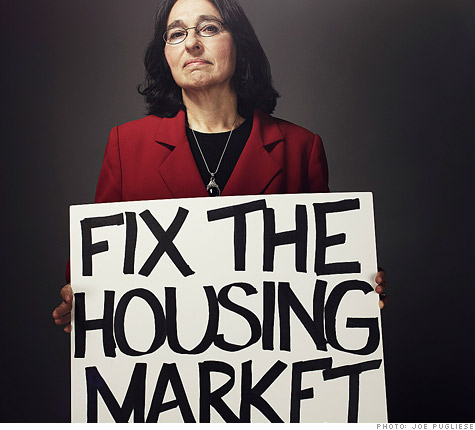
THE ECONOMY: Housing: The one bailout America could really use

(MONEY magazine) -- Laurie Goodman is an apolitical number cruncher who has spent most of her 28-year career out of the public view, studying the minutiae of mortgage-backed securities (MBS) for big investment banks. She's long been a star among Wall Street insiders, however. She holds the record for the most top rankings for fixed-in-come research from the trade bible Institutional Investor.
While Goodman concedes she underestimated the impact of the housing bubble's bursting early on, by mid-2007 she was  warning investors to prepare for a deep downturn. She prepared herself as well. 
After her employer at the time, UBS, shut down its mortgage trading desk in 2008, she jumped to Amherst Securities, a small company that serves as an MBS broker-dealer for big investors. From there she's published research that has raised her profile and made her an oft-cited source by would-be housing reformers in both the private and public sectors. If she is underestimating the problems the housing market has now, we're all in trouble.
Goodman often pauses several seconds before speaking, choosing her words deliberately. So it is especially distressing to hear her warn of a potential housing "death spiral."
On top of the 2.5 million homes that have already fallen to foreclosuresince the bubble burst, another 4.5 million mortgage holders have given up paying and are likely to lose their homes, she calculates.

'Shareholders of the world unite'

Millions more are underwater -- owing more than their home is worth -- and may give up if things don't improve soon. All told, Goodman warns that more than 10 million of the nation's 55 million mortgage holders could default by 2018. If home prices fall much more than the 6% or so she's projecting over the next 12 to 18 months, the picture worsens, as more foreclosures drive prices down further, in turn causing more sheriffs' sales.
Goodman's research into who defaults shows that many governmental and private efforts at saving borrowers -- and reducing investors' losses -- by modifying mortgages weren't helping because they only extended payments or reduced interest rates. They didn't fix the fundamental problem of unsupportable debt loads.
Goodman found that investors lose as much as 70% when the homes underlying their subprime MBS are foreclosed upon. Lenders that tried to rehabilitate delinquent borrowers by reducing the principal (or total amount owed) by an average of 26% were far less likely to have to

Sunday, October 9, 2011

NEW CONSTRUCTION: Affordable housing investment in Allston clicks for Google

When most people hear the name Google, they think Internet searches, not affordable housing.


But in Allston, the search-engine giant is investing $28 million to help construct 240 units at the Charlesview residences, one of the largest low-income housing developments in the country.


On its face, the investment seems strange because it puts Google Inc., typically focused on the virtual world, in a corner of the affordable housing business dominated by big banks and investment companies.


However, Google and other companies know something that others don’t: Rental and low-income housing projects are now among the most lucrative investments available, with businesses from Apple Inc. to Sherwin-Williams Co. buying millions in government tax credits used to finance affordable homes in Massachusetts and other states. These companies use the credits to significantly reduce their tax bills, while builders get desperately needed funds to provide affordable housing to low- and middle-income families.


In its most recent fiscal year, MassHousing, the state’s affordable housing bank, helped provide financing for a record $446 million in rental-housing deals, due in large part to renewed interest among private companies and other investors. That’s up from just $89 million in the 2009 budget year, when the economic downturn dried up funding for such projects.


“A lot of these nontraditional investors have said, ‘Wait a second, this is a good deal,’ ’’ said Greg Judge, chief operating officer of Boston Financial Investment Management, which specializes in low-income housing investments. “It’s affordable housing, so it makes them feel good, has a great investment track record, and it’s one of the best deals around right now.’’


An executive with Google said the technology company was attracted to affordable housing in part because the projects seldom encounter financial difficulties and almost never result in a default.


“We want to be responsible corporate citizens, and that’s what drove us to invest, but the returns are also quite good considering the risk,’’ said Axel Martinez, an assistant treasurer for Google. “Charlesview is one of the places where we were able to add value, when in the past projects like that wouldn’t have gotten done.’’


The Charlesview project, expected to employ hundreds of laborers over the next two years, involves the relocation and expansion of a 213-unit affordable housing complex on Western Avenue that was built in the 1970s and has fallen into disrepair.


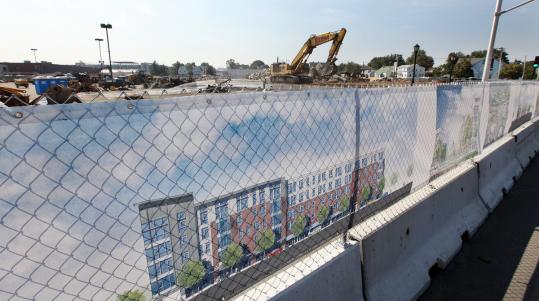
The new Charlesview will be a half-mile down the road, on part of the former Brighton Mills Shopping Center. Its nonprofit developer, Community Builders Inc., is constructing 240 apartments and eventually plans to add a 100-unit condominium tower that will include 26 low- to moderate-income units. The project will also result in a new park, retail stores, a community center, and an underground parking garage.


Developers are allocated tax credits by government agencies, and in turn sell them to investors and use the proceeds for construction. The traditional buyers are banks and lenders that not only use them to lower their tax bills, but to fulfill the requirements of the federal Community Reinvestment Act. The act mandates that lenders fund housing construction, small business development, and other initiatives in the communities where they operate.


The tax credits have become a critical source of funding for affordable housing, but in the aftermath of the financial crisis in 2008, many builders found it difficult to find investors with the wherewithal to finance these projects. Banks and other traditional buyers were saddled with huge losses during the period and withdrew from the market, which forced the federal government to step in to provide funding to keep the sector afloat.


Investors came back to the market in 2010, when banks and other buyers