Showing posts with label Landlords. Show all posts
Showing posts with label Landlords. Show all posts
Tuesday, February 26, 2013

Thursday, January 31, 2013
INVESTMENT PROPERTY: Tips For First-Time Landlords
You can't or don't want to sell your existing home.
If those two statements ring true for you, becoming a landlord might not be a bad idea.You can move to another home for less than the income you could get for renting your home.
The housing recovery is underway, but it could still take years for many homeowners to surface from their underwater status. Selling now would beselling at a loss.
Other homeowners aren't underwater, but don't have enough equity to sell at a decent profit. Selling now could be only a break-even proposition.
Homeowners stuck with a mortgage larger than the value of their home, are cashing in on rising rents by renting out their existing home and moving to a home that costs less - if only temporarily.
The deal can even work if the home you move to costs the same as or even more than your current housing costs, provided your new housing costs are sufficiently offset by the rental income from your existing home.
Do the math
In the best of all worlds, the rent should cover not only your existing home's mortgage, but property taxes, insurance, upkeep and other costs of owning a home. If not, you'll have to make up the difference.
In today's skyrocketing rents market, you likely can swing the rental income you need.
However, you face a greater obstacle than making the deal pencil.
Hiring a property manager could cut into your rental income, but landlording, especially for first-timers, is not a piece of cake.
Take some cues from T.J. Rubin, broker owner of Fulton Grace Realty in Chicago.
He offers some tips to help you make the transition to a new job as a landlord.
Tuesday, October 9, 2012
INVESTMENTS: The income property: Your late-in-life retirement plan
"Income property can be an important bridge to retirement for those without quite enough to retire in the traditional sense," says J. Camarda, a real estate investor, Certified Financial Planner, and Chief Investment Officer of Jacksonville, Fla.-based Camarda Wealth Advisors. Because real estate is such an inefficient market, it's possible to find awesome bargains with a very high return on investment, Camarda says. And if you can manage the property yourself, you can collect more income.
If you purchase the right property at the right price and on the right terms, he says, a rental property can produce significantly more income than traditional passive investments.
This article will describe how much you can expect to invest and earn, how to choose a location for your rental property, and problems that might derail your plans if you aren't careful.
How Much Money Do You Need?
If you plan to finance your purchase with a mortgage, you'll need to take action before you retire, says associate broker Janice Leis, who serves the premier residential areas of Philadelphia and South Florida.
Mortgage lending guidelines typically require applicants to be employed and have at least two years of steady employment history in the same occupation.
Lenders also require a substantial down payment, typically 30% or more, if you won't be occupying the property, says John Walters of LeWalt Consulting Groupe in St. Petersburg, Fla.
If you don't have the cash to make such a large down payment, consider using your IRA funds. All equity growth and income from rental receipts will grow inside your IRA tax-free, Walters says. Purchasing the property with funds inside a Roth IRA, on which you've already paid taxes, means all your earnings and equity can grow tax-free forever, he says.
After you've tackled the hurdle of affording the purchase, you need to think about ongoing expenses. Owning residential income property is like owning a principal residence in that there are variable expenses outside the mortgage, says Rob Albertson, a multi-million dollar residential real estate agent with Austin Fine Properties/PLR in Austin, Texas. There are maintenance costs for minor items (like leaky faucets) and major items (like a new roof).
Don't forget about marketing expenses and periods of vacancy and tenant change-over when you won't be earning income. Albertson recommends factoring no higher than a 92% occupancy rate into your calculations, even in a hot rental market. Be conservative in your estimates of expenses and income.
Tax considerations will also play into what you can afford.
"One of the chief benefits associated with rental property is the ability to claim a depreciation deduction on your federal income tax return," Walters says. Depreciation reduces the value of your property each year to approximate wear and tear. It lowers your tax basis so that you pay less tax on the property when you sell it.
First and foremost, discuss the financial feasibility of your plans with a CPA, a real estate attorney and an insurance agent to see how much everything will cost, recommends Leis.
Get valuable interest rate discounts on select new home equity loans from Wells Fargo.
Choose a Location
Purchasing the least expensive property you can find won't help you earn a return on your
Saturday, September 29, 2012
LANDLORD ISSUES:Boston rental unit inspection plan debated
A proposed ordinance that would require most rental properties in Boston to be inspected once every three years was met with mixed reactions Thursday as city councilors, landlords, and tenants butted heads on whether more inspection requirements would place an unfair burden on responsible landlords.
Discussion of the proposal by the City Council was prompted by Mayor Thomas M. Menino, who earlier this month called for a change to the city’s current law after a slew of high-profile citations were issued against apartments around the city.
In a meeting at City Hall that lasted nearly three hours, city councilors and representatives of tenant and landlord associations bandied ideas on how to target absentee landlords, many of whom live out of state.
Menino’s proposal would require landlords to obtain an inspection once every three years, though property owners with a good track record could apply to opt out. Owner-occupied properties with one to three units would automatically be exempt from the more frequent inspections.
Under current law, rental properties need to be inspected only when units are turned over to new tenants, but landlords rarely notify the city when new tenants move in.
The proposal would also create a database of contact information for all rental property owners, so landlords are easily accessible when problems are identified.
“We’re really going to be able to go after some of these midsized investors that don’t care about Boston, don’t care about the neighborhood, but are now buying a lot of properties,” said Sheila Dillon, director of Boston’s Department of Neighborhood Development.
But many were wary of establishing new rules, saying that they would create undue hardship for responsible property owners. Fees for inspections are $50 per unit for buildings with one to three units, and $75 per unit for buildings with four or more apartments.
Michael Ferguson, facilities director for Peabody Properties, a real estate firm, argued that the ordinance would not be fair to companies like his, which have 24-hour maintenance staff and conduct their own inspections each year.
“We are transparent, compliant, and accountable on a daily basis to our tenants,” Ferguson said.
Councilor Mark Ciommo pushed for the exemption to be extended to properties with up to six units.
Councilor Michael P. Ross said he recognized the need for more accountability but hoped for something “very liberal, very exempting.”
“I don’t think we need a system that punishes the entire real estate industry for the bad apples,” Ross said. “I think we need a system that goes after the bad apples.”
Ninety-eight percent of inspections performed by the Inspectional Services Department on rental properties are prompted by complaints, usually from tenants or neighbors, according to the department.
Brian Swett, chief of the Office of Environmental and Energy Services, said the city needs a more proactive system that identifies small code violations before they become larger health and safety hazards.
Several councilors were skeptical that the Inspectional Services Department would be able to handle the increased workload. Inspection officials projected that they would have to conduct 50 percent more inspections per year, requiring 12 additional employees.
Bryan Glascock, acting commissioner of the Inspectional Services Department, said the fees would just about exactly cover the costs of the additional inspectors. Councilor Tito Jackson was not convinced.
“It’s a big deal when you come before the council and you’re asking for 50 percent more
Discussion of the proposal by the City Council was prompted by Mayor Thomas M. Menino, who earlier this month called for a change to the city’s current law after a slew of high-profile citations were issued against apartments around the city.
In a meeting at City Hall that lasted nearly three hours, city councilors and representatives of tenant and landlord associations bandied ideas on how to target absentee landlords, many of whom live out of state.
Menino’s proposal would require landlords to obtain an inspection once every three years, though property owners with a good track record could apply to opt out. Owner-occupied properties with one to three units would automatically be exempt from the more frequent inspections.
Under current law, rental properties need to be inspected only when units are turned over to new tenants, but landlords rarely notify the city when new tenants move in.
The proposal would also create a database of contact information for all rental property owners, so landlords are easily accessible when problems are identified.
“We’re really going to be able to go after some of these midsized investors that don’t care about Boston, don’t care about the neighborhood, but are now buying a lot of properties,” said Sheila Dillon, director of Boston’s Department of Neighborhood Development.
But many were wary of establishing new rules, saying that they would create undue hardship for responsible property owners. Fees for inspections are $50 per unit for buildings with one to three units, and $75 per unit for buildings with four or more apartments.
Michael Ferguson, facilities director for Peabody Properties, a real estate firm, argued that the ordinance would not be fair to companies like his, which have 24-hour maintenance staff and conduct their own inspections each year.
“We are transparent, compliant, and accountable on a daily basis to our tenants,” Ferguson said.
Councilor Mark Ciommo pushed for the exemption to be extended to properties with up to six units.
Councilor Michael P. Ross said he recognized the need for more accountability but hoped for something “very liberal, very exempting.”
“I don’t think we need a system that punishes the entire real estate industry for the bad apples,” Ross said. “I think we need a system that goes after the bad apples.”
Ninety-eight percent of inspections performed by the Inspectional Services Department on rental properties are prompted by complaints, usually from tenants or neighbors, according to the department.
Brian Swett, chief of the Office of Environmental and Energy Services, said the city needs a more proactive system that identifies small code violations before they become larger health and safety hazards.
Several councilors were skeptical that the Inspectional Services Department would be able to handle the increased workload. Inspection officials projected that they would have to conduct 50 percent more inspections per year, requiring 12 additional employees.
Bryan Glascock, acting commissioner of the Inspectional Services Department, said the fees would just about exactly cover the costs of the additional inspectors. Councilor Tito Jackson was not convinced.
“It’s a big deal when you come before the council and you’re asking for 50 percent more
Thursday, August 16, 2012
RENTALS: The Cheapest, Priciest Areas to Rent an Apartment in the Hub
Everybody knows it's bad out there fortenants and very likely getting worse (forlandlords, not so much). The latest quarterly report from RentJuice/Zillow, covering approximately 85 percent of the apartment availabilities in Greater Boston, only reinforces the point.
Just take the aggregates: the average apartment rent for Boston proper in the first quarter of 2012 was $2,228, and in the second quarter was $2,503; the average apartment rent for Greater Boston was $2,218 in the earlier quarter, and $2,308 in the quarter ending June 30. Rents in some areas in particular were way up: North Cambridge, 20 percent; Belmont, 42 percent. Some were down: the rest of Cambridge, East Boston. Generally, though, the numbers reflect a rental market that appears to be trending toward ever-more demand amid tight supply, no matter how much construction there is or is planned (check out our Rental Heatmap for that).
The only real bright spot for tenants might be the availabilities coming up after the summer: Seven out of 10 rental listings being marketed now, according to the report, are noted as becoming available in early September. So there's that.
The 20 most expensive areas:
Wellesley $4,435
Waterfront $4,255
The Harborfront* $3,667
Belmont $3,520
Needham $3,469
Arlington $3,438
Theater District $3,435
West End $3,368
Back Bay $3,328
Kendall Square $3,280
Seaport $3,262
Downtown Boston $3,256
South Boston $2,969
Bay Village $2,914
East Cambridge $2,904
South End $2,890
Teele Square $2,876
Brookline Village $2,875
Union Square $2,870
Central Square $2,853
And now the 20 cheapest:
Waterfront $4,255
The Harborfront* $3,667
Belmont $3,520
Needham $3,469
Arlington $3,438
Theater District $3,435
West End $3,368
Back Bay $3,328
Kendall Square $3,280
Seaport $3,262
Downtown Boston $3,256
South Boston $2,969
Bay Village $2,914
East Cambridge $2,904
South End $2,890
Teele Square $2,876
Brookline Village $2,875
Union Square $2,870
Central Square $2,853
And now the 20 cheapest:
Framingham $1,363
Everett $1,377
Norwood $1,512
Quincy $1,544
Everett $1,377
Norwood $1,512
Quincy $1,544
Saturday, August 4, 2012
BOSTON HOUSING NEWS: Boston, developers betting tiny Seaport apartments will be a big thing

A small platform, painted black with images of kitchen appliances and living room furniture outlined in bright neon, was celebrated Thursday as the future of housing in Boston’s fast-growing Seaport District.
The platform, with a faux wall on one side, was a mock-up of the ultrasmall apartments under construction at the Seaport’s newest residential building, the Boston Wharf Tower on A Street. With units as small as 450 square feet, the apartments fit Mayor Thomas M. Menino’s call for more affordable housing in the district for young professionals who want to live near work and social attractions.
“From the very start of our plan for the waterfront and Fort Point Channel, we knew housing would be a crucial part of the equation,” Menino said Thursday during a ceremonial ground-breaking at that $100 million Boston Wharf Tower. “This project will help turn this neighborhood
Friday, August 3, 2012
MARKET TRENDS: Millennial (Echo Boomers) Generation: A Look At Housing Desires And Rental Needs
The housing and credit crisis has made being frugal very trendy. It’s now "cool" to save money rather than waste money. Even big banks are cashing in on the trend and coming up with hip tag lines like, "frugal is the new cool" as they promote ads and videos online that help consumers learn ways to save money.
The Millennials (those born 1980-1995, approximately–there is some disagreement about the exact years) share some specific desires regarding their housing needs. They want to drive less and have public transportation nearby. They don’t necessarily need or want to own right now. Instead, they might prefer to have a newer, hip and modern place they rent over one they own and have to fix up. They may be strapped for cash, so they want amenities included in the rent–like the use of a gym. Small is good for them since this generation is trying to save money on things like their utility bills.The poor economic times are causing some major shifts in homeownership. Many young people are opting to rent longer rather than buy partly driven by the fact that they can’t afford a downpayment or don’t qualify for a loan. Also, there is a larger than ever percentage of single people. These smaller households are seeking highly walkable places to live and work.
While renting may be the solution for many in this generation, some younger people still want to own their own home. In particular, single moms and women from the Millennial generation view homeownership as important to them. Making that happen could be difficult if they don’t take
Tuesday, July 3, 2012
RENTALS: 48% of property managers say rents rose over past 12 months: TransUnion

Roughly 48% of property managers surveyed by TransUnion said rental prices increased over the last 12 months on the majority of their properties.
The credit firm surveyed more than 1,200 large and small managers. Last year, less than 40% of respondents said rents were rising.
Roughly 70% of large managers, those handling more than 200 properties, said rents increased from last year.
"The rise in rental prices, coupled with a decrease in vacancy rates and the ability to attract new residents with less effort are all positive signs for the market and rental property managers," said Steve Roe, vice president of TransUnion rental screening solutions.

Even though rents are rising, demand remains high and managers are not having a problem locating new residents, according to the survey.
Nearly 73% of the managers said it was not difficult to find new occupants, compared to 67% last year.
The survey showed 83% of managers said vacancy rates were less than 5%, and more than 70% reported no vacancies.
Investors and would-be property managers flooded the Federal Housing Finance Agency with applications to take advantage of the rental boom. The agency continues to work on a pilot program to rent out previously foreclosed homes owned by Fannie Mae.
It will closely monitor how these property managers handle the homes in still fragile markets.
More than half of small property managers said they had a renter "skip out" on a unit and left
Saturday, June 16, 2012
MARKET TRENDS: Landlord imposes smoking ban on 2,000 California apartments
It recently became legal for California landlords to forbid apartment renters from smoking in their units, but few property owners do so.
In a decision affecting nearly 2,000 units in 13 apartment complexes, the Towbes Group Inc. of Santa Barbara said it has become the largest apartment portfolio in California to impose a no-smoking policy on individual units and common areas.
Starting this month, new residents of Towbes Group's apartments in Ventura, Goleta, Santa Maria, Lompoc and Santa Barbara may no longer smoke in their units. Residents who moved in earlier have until the end of the year to comply with the new restrictions.
In addition to addressing secondhand smoke concerns, the prohibition on lighting up offers a financial boost to landlords, said Jim Carrillo, a Towbes vice president. His company "turns" about 1,000 units a year, which means they must be cleaned for new residents. The process costs about twice as much if the last tenant was a smoker.
"You can mask it with paint, but in order to totally remove the residue you have to scrape the walls," Carrillo said, then put on primer and more layers of paint. Countertops and cabinets may also need intense cleansing treatments.
The landlord was partly inspired to make the change after spending $4,000 on insulation, caulking and other efforts to find and cover every possible opening between a smoker's apartment and a nonsmoker's apartment.
Since a majority of the company's tenants were nonsmokers, company officials reasoned
Sunday, May 6, 2012
RENTALS: Rising rents mean bad news for renters, economy
The less rooms for rent, the more they cost.
“We expect strong demand and constrained supply to contribute to rental inflation of 3% or so in 2012, and for landlords’ rental yields to improve to 5.75%,” Capital Economics analysts said. “That would comfortably beat the yields available on Treasurys.”
In other words, rents are rising. While this is great for landlords and multifamily investors who stand to make a nice profit, could families who moved to find a cheaper place to live be forced to downgrade even more?
Turns out, yes. According to the U.S. Commerce Department, the median rent was $721 per month in the first quarter of 2012, up 5.6% from a year earlier. There is no sign that prices will slow any time soon.
While this will make it more difficult for would-be renters to find a place to live, it may spell worse things for the economy as a whole. On Monday, The Wall Street Journal reported the numbers could mean a boost to inflation.
“Actual rents influence what homeowners think their own homes would rent for. And within the consumer-price report, rents and owners’ equivalent rent account for 40% of the core index that excludes volatile food and energy items,” it said. “In March, yearly shelter inflation was running about 2.1%, setting a floor under core inflation, which was running at a 2.3% annual pace.
“According to the Fed’s own forecasts, core inflation (measured slightly differently than the
Monday, April 9, 2012
MARKET TRENDS: Rents keep rising as home prices stagnate
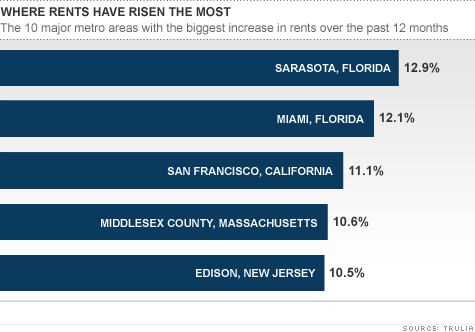
While asking prices for homes declined 0.7% over the past 12 months through March, rents rose 5%, according to a report released Thursday by real estate listing site Trulia. Quiz: What the rich really pay in taxes
Several metro areas recorded double-digit percentage increases in rental rates. In Sarasota, Fla., the average rent jumped 12.9% year-over-year, the biggest increase of any of the 100 largest metro areas Trulia surveyed. Miami and San Francisco saw the next biggest increases, with rent hikes of 12.1% and 11.1%, respectively.
The metro areas that sustained the highest rent increases were a decidedly mixed bag, but obviously shared one factor: rising demand for a limited supply of rental units.
Low-ball appraisal: Mortgage denied
The national vacancy rate for apartments fell 0.3 percentage points during the first quarter to 4.9%, its lowest point since late 2001, according to a separate report from Reis Inc., a real
Tuesday, March 27, 2012
NEW CONSTRUCTION: Charlestown lofts project ready to be developed
After a 17-year tussle over permits, Boston developer Michael Rauseo is finally moving forward with a project to transform a century-old warehouse in Charlestown into 124 loft-style apartments.
Rauseo, owner of the Suffolk Cos., said he will start a $40 million renovation of the long-vacant Terminal Storage Building at 267 Medford St. this summer, hoping to get the apartments ready for occupancy by fall 2013.
Even by the standards of Boston, where neighborhood opposition and quirky development rules can add years to a building project, Rauseo’s experience borders on the extreme.
After winning city approval in 1995, he hit a legal snag because of the project’s location near what used to be an active industrial port on the Mystic River; its location just inland from the riverfront put it in a state-defined district known as a “designated port area,’’ where law prevented construction of residences.
He is among several developers trying to take advantage of a burgeoning market for rental apartments. With vacancy rates low and many people opting to rent instead of buy, apartments are seen as a good investment by developers and lenders that provide financing for such projects.
The building, situated next to Charlestown High, will qualify for tax credits due to its recent inclusion in a federally recognized historic district. The National Park Service granted historical
Thursday, March 1, 2012
RENTAL MARKET: Renters face fewer vacancies, rising rates
NASHVILLE – During the boom years of home buying, property manager Charlie Biter used to offer new apartment tenants one or two months' free rent as a lease enticement. Now, as rental demand continues to surge, no such offers are necessary.

By Samuel Simpkins, The Tennessean
Would-be renter Doug Richesin checks out an apartment complex in Nashville.
"Back then, everybody was being creative to bring renters in," said Biter, who oversees 2,000 apartment units in the Nashville area for Continental Property Management. "But now I'm not aware of any units offering concessions."
Across the country, as more people compete for apartments in the wake of the housing collapse, the market has swung in favor of landlords. For tenants, that means saying goodbye to move-in incentives and watching rents edge higher.
About a quarter of all apartments nationwide offered some type of concession in last year's fourth quarter. By comparison, 53% of apartments offered concessions in the first quarter of 2010, according to data tracker MPF Research's latest report.
"The industry moves in cycles, and right now not a lot of apartments are available," said Jay Parsons, an analyst at MPF Research. Until apartment construction catches up to demand, landlords will maintain their control of the market, he said.
The vacancy rate in Pittsburgh, at 2.2%, is among the lowest in the country, according to MPF's fourth-quarter data from 2011. University of Pittsburgh master's student Harrison Murphy knows the difficulty first-hand. Four years ago, he found an apartment within an hour of searching, he said. Now, not only are rentals harder to come by, but many landlords are requiring stricter background checks.
"I have been unable to find a single place that doesn't require a recommendation from your previous landlord, with some even asking for recommendations from teachers," Murphy, 24, said.
In New York, too, as rental demand swells in some of the most desirable neighborhoods, rates are reaching new highs. In 2011, average rents across all
Sunday, January 22, 2012
RENTALS: Know Your Heating Rights When The Temperature Drops
On this frigid January day, we can’t help but think about our fellow New Yorkers who might be without heat, like one unlucky mom on UrbanBaby.com who says she has been without heat for a week while trying, fruitlessly, to get the attention of her management company.
As commenters there correctly observe, heat complaints are a top priority for the city — meaning you don't have to fight this battle alone.

Here’s a reprise on your right to heat and hot water:
Heat season begins October 1st and runs through May 31st. Apartments must maintain a temperature of at least 68 degrees Fahrenheit between 6 a.m. and 10 p.m. when the temperature outside is below 55 degrees.
At night, between 10 p.m. and 6 a.m., indoor temperature must be at least 55 degrees when the outside temperature drops below 40 degrees. Hot water must be maintained at 120 degrees during heat season.
If your heat is lagging, first contact the building owner, manager, or super.
Still cold? Call in complaints to 311. All complaints are investigated. Building owners can be fined up to $500 a day for first violations and up to $1,000 per day for subsequent violations
As commenters there correctly observe, heat complaints are a top priority for the city — meaning you don't have to fight this battle alone.
Here’s a reprise on your right to heat and hot water:
Heat season begins October 1st and runs through May 31st. Apartments must maintain a temperature of at least 68 degrees Fahrenheit between 6 a.m. and 10 p.m. when the temperature outside is below 55 degrees.
At night, between 10 p.m. and 6 a.m., indoor temperature must be at least 55 degrees when the outside temperature drops below 40 degrees. Hot water must be maintained at 120 degrees during heat season.
If your heat is lagging, first contact the building owner, manager, or super.
Still cold? Call in complaints to 311. All complaints are investigated. Building owners can be fined up to $500 a day for first violations and up to $1,000 per day for subsequent violations
Friday, December 16, 2011
MULTIFAMILY HOME LOANS: Loans for Multifamily Homes
THE rental market’s strength may be enticing some buyers to look at multifamily properties, but qualifying for a mortgage on rental units is often more difficult than on a single-family residence.

“It looks a lot easier than it is,” said Neil B. Garfinkel, a partner in charge of the real estate practice at Abrams Garfinkel Margolis Bergson, suggesting that anyone new to this subject work with a real estate professional experienced in rental properties.
But the extra effort may be worthwhile for some people looking for income, or at least help with covering monthly expenses.
A recent report by Frank E. Nothaft, the chief economist for Freddie Mac, noted that “the rental market has been a bright spot in the housing sector this year,” as more households postpone home-buying because of the uncertain economy. The overall rental vacancy rate in Manhattan is hovering around 1 percent, while rents are up for all kinds of apartments.
Mr. Garfinkel, who is also an owner of apartments in Brooklyn and the Bronx through aninvestment firm, says buyers of multifamily property will need to do their due diligence on all the active leases and any service contracts for the building, including the employment terms of the superintendent.
Some lenders are more comfortable lending for property with tenants in place, said John Manning, a
Saturday, November 5, 2011
INVESTING: Buying Your First Investment Property
Given today’s low housing prices and interest rates, it is easy to understand why so many people are considering purchasing an investment property for the first time in their lives. While you will have to take a few extra steps when purchasing an investment property versus an owner occupied property, buying investment property can certainly be quite rewarding. Before you take this step, however, it is important to learn a bit more about what purchasing an investment property entails.
Financing Your Purchase
Financing the purchase of an investment property can be a bit trickier than purchasing a home to occupy. When purchasing an investment property, you should be prepared to make a down payment that is equivalent to 20 percent of the cost of the home. Furthermore, the funds you use for your down payment cannot be a gift. In some cases, the seller can contribute up to 2 percent toward the closing costs an you may be able to have a second mortgage of up to 85 percent of the cost, but taking advantage of these offers will make it more difficult to obtain a loan. The same is true when it comes to your credit score, as those with low scores will be hit with higher interest rates.
Having Funds in Reserve
In addition to having enough money to put down as a down payment, most guidelines also require you to have six months reserves in your savings account by the time the transaction is complete. The six months reserve includes the amount needed to cover your mortgage payment for six months as well as any home owners association dues. Retirement funds and stocks can count as your retirement reserve, but lenders will discount the value of these to 60 or 70 percent when determining their reserve value.
Using Special Programs
For those who need a little help with purchasing an investment property, there are two options available: Fannie Mae Homepath and FHA. With a Fannie Mae Homepath Mortgage, you can put as little as 10 percent down on a property that has been designated for the program. No
Monday, August 1, 2011
RENTAL MARKET: Rents hit a record high in Hub area
Tenants scramble to find vacancies in a tight market.
Boston-area rents are hitting new heights - with the median price recently reaching $1,665 a month - as the vacancy rate falls to the lowest level in almost a decade, new data show.
In a region long known for its costly housing, the tight rental market has left many frustrated apartment seekers scrambling to find places they can afford before Sept. 1, the area’s traditional changeover date. Facing competition, some renters are taking properties sight unseen. Others, answering ads, find apartments already snatched up before they can get a tour.
“This is the tightest it’s been,’’ said Ishay Grinberg, chief executive of RentalBeast.com, a Somerville company that has provided a database of apartments for renters since 2003. “We have a significant number of companies that have zero vacancies.’’
Record-high rents in the Boston area - loosely defined as the region bounded by Interstate 495 - were reached during the second quarter of this year after recovering from the 2008 financial crisis, which deflated rents around the country, according to Reis Inc., a New York company that tracks rental data.
Boston is the fifth-most-expensive rental market in the country, behind Fairfield County in Connecticut, Westchester County in New York, San Francisco, and New York City, according to Reis.
The vacancy rate for Boston-area apartments dropped to 4.4 percent in the second quarter of the year, down from 6.2 percent a year earlier, and is the lowest it has been since the end of 2002, according to Reis.
RentalBeast.com reports that availability in some neighborhoods such as Beacon Hill and the Back Bay is even tighter - at about 1.2 percent. Rents are also higher, with a two-bedroom in the Back Bay averaging $2,658, compared to $2,316 in Charlestown, according to RentalBeast.com.
Prices are heading up as inventory shrinks, largely because of the stalled housing market, the foreclosure crisis, and the growing graduate student population, said Barry Bluestone, dean of the School of Public Policy and Urban Affairs at Northeastern University.
In Massachusetts, the foreclosure crisis forced many homeowners into apartments, while many young people who normally would purchase homes can’t get financing or are concerned home prices will continue to slide. Sales of single-family homes in the state slowed by nearly 20 percent during the first five months of the year, according to the Warren Group, a Boston company that tracks real estate.
At the same time, Boston’s population of graduate students is growing, while few new housing units are being built. Over the past decade, about 20,000 graduate students have been added to the Boston area, Bluestone said.
“We continue to have a serious affordability problem,’’ he said. “Prices stay high and are now at an all-time high level, despite the fact the economy is very weak.’’
Nancy McCreary, the manager of Hammond Rental Group in Chestnut Hill, said this is good news for landlords, many of whom were not able to raise rents for several years. She said it also will help the real estate market; more investors - seeing a potential for profit - are becoming interested in purchasing rental properties, she said.
Boston-area rents are hitting new heights - with the median price recently reaching $1,665 a month - as the vacancy rate falls to the lowest level in almost a decade, new data show.
In a region long known for its costly housing, the tight rental market has left many frustrated apartment seekers scrambling to find places they can afford before Sept. 1, the area’s traditional changeover date. Facing competition, some renters are taking properties sight unseen. Others, answering ads, find apartments already snatched up before they can get a tour.
“This is the tightest it’s been,’’ said Ishay Grinberg, chief executive of RentalBeast.com, a Somerville company that has provided a database of apartments for renters since 2003. “We have a significant number of companies that have zero vacancies.’’
Record-high rents in the Boston area - loosely defined as the region bounded by Interstate 495 - were reached during the second quarter of this year after recovering from the 2008 financial crisis, which deflated rents around the country, according to Reis Inc., a New York company that tracks rental data.
Boston is the fifth-most-expensive rental market in the country, behind Fairfield County in Connecticut, Westchester County in New York, San Francisco, and New York City, according to Reis.
The vacancy rate for Boston-area apartments dropped to 4.4 percent in the second quarter of the year, down from 6.2 percent a year earlier, and is the lowest it has been since the end of 2002, according to Reis.
RentalBeast.com reports that availability in some neighborhoods such as Beacon Hill and the Back Bay is even tighter - at about 1.2 percent. Rents are also higher, with a two-bedroom in the Back Bay averaging $2,658, compared to $2,316 in Charlestown, according to RentalBeast.com.
Prices are heading up as inventory shrinks, largely because of the stalled housing market, the foreclosure crisis, and the growing graduate student population, said Barry Bluestone, dean of the School of Public Policy and Urban Affairs at Northeastern University.
In Massachusetts, the foreclosure crisis forced many homeowners into apartments, while many young people who normally would purchase homes can’t get financing or are concerned home prices will continue to slide. Sales of single-family homes in the state slowed by nearly 20 percent during the first five months of the year, according to the Warren Group, a Boston company that tracks real estate.
At the same time, Boston’s population of graduate students is growing, while few new housing units are being built. Over the past decade, about 20,000 graduate students have been added to the Boston area, Bluestone said.
“We continue to have a serious affordability problem,’’ he said. “Prices stay high and are now at an all-time high level, despite the fact the economy is very weak.’’
Nancy McCreary, the manager of Hammond Rental Group in Chestnut Hill, said this is good news for landlords, many of whom were not able to raise rents for several years. She said it also will help the real estate market; more investors - seeing a potential for profit - are becoming interested in purchasing rental properties, she said.
Tuesday, July 12, 2011
NEIGHBORHOODS: Rethinking a hospital site
What to do with Medfield State Hospital? New ideas raised on how to reuse Medfield State as 80-acre cleanup nears end
Six years after an environmental cleanup began at the closed institution for mentally ill patients, 80 acres that are slated for redevelopment, about a third of the grounds, should be clear of contaminants this summer.
![]()
But state and local officials still do not agree on what should go there.
Some people suggest housing, others favor medical or research facilities. There are some who would like to see a college or university, and others who want nothing more than a riverside park there.
While new leadership at the state Division of Capital Asset Management has brought fresh energy to the process - a meeting with Medfield officials is scheduled at the State House next Monday - the future of the hospital grounds is still uncertain.
“What I’ve said to the selectmen is, let’s kind of start over and take a fresh look,’’ said Carole Cornelison, who took over as commissioner in March. “Let’s take a fresh look at what all of the possible options are, together. This is not a push-down, and it’s not a them-versus-us scenario.’’
Six years after an environmental cleanup began at the closed institution for mentally ill patients, 80 acres that are slated for redevelopment, about a third of the grounds, should be clear of contaminants this summer.

But state and local officials still do not agree on what should go there.
Some people suggest housing, others favor medical or research facilities. There are some who would like to see a college or university, and others who want nothing more than a riverside park there.
While new leadership at the state Division of Capital Asset Management has brought fresh energy to the process - a meeting with Medfield officials is scheduled at the State House next Monday - the future of the hospital grounds is still uncertain.
“What I’ve said to the selectmen is, let’s kind of start over and take a fresh look,’’ said Carole Cornelison, who took over as commissioner in March. “Let’s take a fresh look at what all of the possible options are, together. This is not a push-down, and it’s not a them-versus-us scenario.’’
Sunday, July 10, 2011
NEIGHBORHOODS: Fenway facelift continues
A proposed complex on Boylston Street would mix housing, retail, further contributing to a neighborhood’s transformation
Fenway Park may remain a fixture in time, but the neighborhood around it is finally completing its transformation to the modern world.
![]()
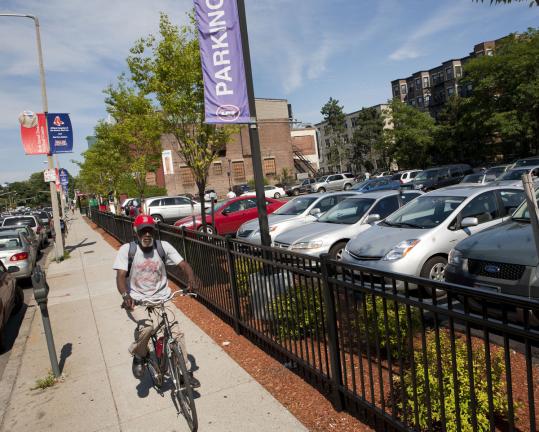
The sub shops, fast food outlets, and gas stations that used to dominate the outer stretch of Boylston Street around the ballpark have given way to sleek buildings, stylish restaurants, and a lively club scene.
And now a new addition to the neighborhood: Boston developer the Abbey Group yesterday proposed construction of a mixed-use complex that would replace a former McDonald’s with 210 apartments, offices, and retail stores.
In a filing submitted to the Boston Redevelopment Authority, Abbey Group executives proposed a tiered complex that would be set back from Boylston Street, leaving room at street level for outdoor cafe tables and a small courtyard. The development, to be located at 1282 Boylston St. next to the Baseball Tavern, would be 16 stories at its peak and step down to four stories on the rear side facing the residential portion of the neighborhood.
“We’re trying to create a building that fits with the urban village objective and really targets a multigenerational group of people,’’ said David Epstein, president of Abbey Group. “We want to shape the building with varied heights and varied openings so it will present itself in a more pedestrian-friendly way.’’
Fenway Park may remain a fixture in time, but the neighborhood around it is finally completing its transformation to the modern world.
The sub shops, fast food outlets, and gas stations that used to dominate the outer stretch of Boylston Street around the ballpark have given way to sleek buildings, stylish restaurants, and a lively club scene.
And now a new addition to the neighborhood: Boston developer the Abbey Group yesterday proposed construction of a mixed-use complex that would replace a former McDonald’s with 210 apartments, offices, and retail stores.
In a filing submitted to the Boston Redevelopment Authority, Abbey Group executives proposed a tiered complex that would be set back from Boylston Street, leaving room at street level for outdoor cafe tables and a small courtyard. The development, to be located at 1282 Boylston St. next to the Baseball Tavern, would be 16 stories at its peak and step down to four stories on the rear side facing the residential portion of the neighborhood.
“We’re trying to create a building that fits with the urban village objective and really targets a multigenerational group of people,’’ said David Epstein, president of Abbey Group. “We want to shape the building with varied heights and varied openings so it will present itself in a more pedestrian-friendly way.’’
Friday, July 8, 2011
Developers across the Boston area are moving forward with a number of large construction projects that were stalled by the recession, creating thousands of jobs and ending one of the state’s most prolonged building slumps.
![]() At least nine major developments are under construction or preparing to begin, including two multibillion-dollar complexes in Boston’s Seaport District, the 60-acre Assembly Row project in Somerville, and a mini-city taking shape on the site of the former South Weymouth Naval Air Station.
At least nine major developments are under construction or preparing to begin, including two multibillion-dollar complexes in Boston’s Seaport District, the 60-acre Assembly Row project in Somerville, and a mini-city taking shape on the site of the former South Weymouth Naval Air Station.
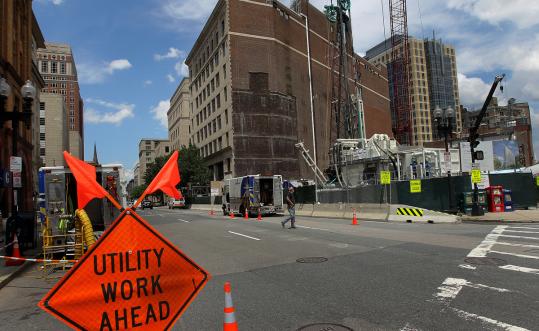
Together, the projects promise to create some 4,000 construction jobs in coming months, with many thousands more possible as work escalates. The increased activity offers a measure of relief to an industry beset by extreme joblessness. At the height of the recession, labor leaders were reporting a 35 percent unemployment rate among construction workers, more than three times the rate of the broader economy.
The developments moving forward include office towers and stores that can help revitalize gritty urban neighborhoods, biotechnology laboratories that will host cutting-edge research, and thousands of apartments that will help curb the shortage of rental housing in the region.
Together, the projects promise to create some 4,000 construction jobs in coming months, with many thousands more possible as work escalates. The increased activity offers a measure of relief to an industry beset by extreme joblessness. At the height of the recession, labor leaders were reporting a 35 percent unemployment rate among construction workers, more than three times the rate of the broader economy.
The developments moving forward include office towers and stores that can help revitalize gritty urban neighborhoods, biotechnology laboratories that will host cutting-edge research, and thousands of apartments that will help curb the shortage of rental housing in the region.
Subscribe to:
Posts (Atom)