Showing posts with label Moving. Show all posts

Tuesday, August 14, 2012

MOVING: Which items often get broken during a move?


If you're moving to a new house or apartment, be advised: Some things are made to be broken.

When it comes to moving, you've got to be careful.
That's because some things - no matter how sturdy they appear on the surface - are made to be broken.
"People don't realize how big of a job it can be," says John Bisney, a spokesman for the American Moving and Storage Association. "They think, 'No big deal, load up a U-Haul and we're good to go.' "
But breaking items during the moving process can be a big deal. Whether you go with the do-it-yourself (DIY) route or hire a moving company, the hassle of replacing or repairing busted items can cost time, money, and, in some cases, broken hearts.
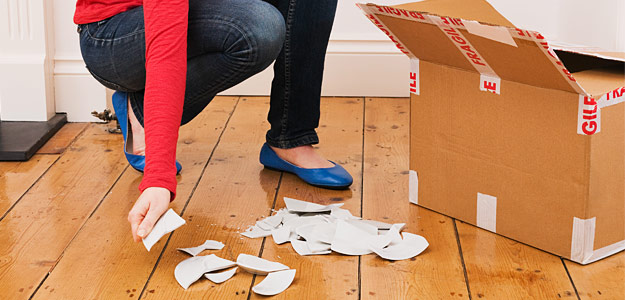
Which items are among the most likely to get smashed and dashed at moving time? Keep reading to find out...
#1 - Electronics
Computers, TVs, and home entertainment systems are among the most likely victims of breakage when it comes time to  move. If you drop electronics, the sensitive and delicate components can suffer major damage.
A possible solution?
Save the boxes and packing materials that originally came with the items, says Abbey Claire Keusch, a professional organizer based in Los Angeles. When the time comes to transport the gear to your next home, re-pack your gadgets in the boxes and materials the way you purchased them.
#2 - Your Back
Back pain, pulled muscles, and broken bones are among the physical injuries you can suffer by trying to move that refrigerator or piano without the right equipment or people power.
"Moving is hard physically and emotionally," says Steve Weitekamp, president of the California Moving and Storage Association.
From the physical standpoint, moving is a strenuous activity that adds a measure of danger when you have to move items up flights of stairs or repetitively lift heavy objects. On top of that, you're asking for trouble if you try moving things by walking backwards.
The Smithsonian's Museum Conservation Institute, a resource center for technical information, writes on its website that you should always face forward when moving furniture to lessen your chances of falling. Otherwise, use a cart for larger pieces and go over the moving route in advance.
#3 - Tables
Wrestling with tables or other odd-shaped items during a move can be a recipe for disaster if you're in DIY mode. These items can be clunky, bulky, or a logistical nightmare at best,

Thursday, August 2, 2012

MOVING: What to Leave Behind


Congratulations on selling your home! Now comes to "fun" part of packing up all those clothes, toys, and pots and pans. It's a lot of working rounding up all the items you need to take with you, but what about the things that stay behind?

Let's take a look at these leave behind items.
There are items that you are either contractually obligated to leave or those that would be kind to leave the new owners.


  • Appliances: Leaving appliances behind may have been part of your sales contract. This can range from the refrigerator and dishwashers to washer and dryer. It's important that you follow these contractual agreements exactly.
  • Manuals: Be sure to leave the new owners a folder full of all appliance and system manuals. This will make their transition into a new home a breeze.
  • Extra Keys: Even though many homeowners will change their locks, you may have extra keys laying around for sheds, front doors, and garage doors. Consider leaving these behind. You'll have no use for them and the new owner may appreciate not having to make copies right away.
  • Security alarm and garage door codes: There's nothing more frustrating than having a fancy garage door with code access ... and no codes or manual for resetting. Be kind and leave behind either the manual or instructions!
  • Warranty Information: Your home warranties will transfer to the new owner upon sale of the home. Leave all this information behind.
  • Service Contacts: It takes new homeowners a while to get their bearings. There's a lot of
  • Monday, November 14, 2011

    MOVING: Moving during the holidays

    It's the holiday season! For many readers out there this season is taking on a whole new meaning.

    Buying happens for a myriad of reasons and during every month of the year. Yet, buying during the holidays can be challenging, especially if you're a family with lots of traditions or with children.Cold weather, rain, and snow doesn't keep a good buyer down. There are great deals to be had all year round. Buying doesn't always happen on schedule. It can take weeks or months to find the perfect house, you may need to move suddenly to follow a new job opportunity, or move to be closer to ailing parents.

    If you have children, then here are some tips to make a move during the holidays a big deal in a good way!

    First, children follow the lead of their parents. If you are depressed about missing out on Aunt Sue's famous turkey or daily noting the bad luck of buying during the holidays, your children will likely pick up on this. So start by adjustingyour attitude first. Focus on the positive aspects of the move. Try to keep a cheery, upbeat attitude.

    Will a child be getting their own room? Will their new room be "awesome"? These can be reasons to celebrate! Talk up all the great new area parks, restaurants, and kid-friendly attractions.

    Tuesday, November 1, 2011

    BUYING A HOME: Should I buy or rent?

    NEW YORK (CNNMoney) -- For the last three years, my husband and I have been renting a house. But I would rather buy than throw my money away on rent. Still, even though we have about $120,000 in savings, great credit and no debt, my husband is reluctant. The job he's had the past two years took 15 months to find, and it pays a lot less than his previous job. He's afraid buying now isn't a good idea because of the shaky economy. What do you think: Should we buy or continue renting? -- Jean J.


    First things first, I want to dispel the belief that you are throwing money away on rent.


    This is a self-serving notion real estate agents often spout that not only isn't true, but isn't a basis for making a rational decision when it comes to buying versus renting.


    Fact is, when you rent, you are buying. You're buying a service: the use of a house for a specified period of time. And as long as the rent you're paying is in line with what others are paying for comparable digs, then you're getting that service at the market rate.


    Granted, you don't have some of the potential plusses of ownership, such as seeing the value of your home climb over the years. But renting has other advantages. You can move more easily, and you're not on the hook for real estate taxes and upkeep. And the money that would have gone into your house can be spent on other things or go into other assets.


    Besides, as recent experience has shown, house price appreciation is hardly a given. Many people who bought during the most recent housing bubble now owe more on their mortgage than their home is worth.


    Buying is cheaper than renting in most cities
    That's not to say a house can't be a good investment. It can. But whether it is depends on a variety of factors, ranging from the price you pay to the prospects for the market you're in to the tax advantages you get and how long you remain in the house.


    There are some gauges, such as a "house P/E ratio," that may be able to give you a sense of whether buying may be a better deal than renting. But, just as with stocks, no single metric can tell the whole story. Besides, in the case of a house, the decision to rent or buy isn't just a financial one. There are personal and lifestyle issues that matter just as much as the numbers.


    So given all that, I recommend you ask yourselves these four questions before you make any move:


    1. Why do you want to own?
    It sounds like both you and your husband would prefer to be owners, but he's just not that sure about the timing. In order to rationalize a change in your living situation, you both want to see a benefit.


    First, you and your husband need to discuss how owning would differ from renting. Would it improve your quality of life? If so, how? Would it be possible to achieve the same goal renting somewhere else instead of buying?


    If you can't come up with several concrete ways your lives would be better as homeowners, then it may not be worth it to go through the trouble of moving and taking on the extra financial responsibility.


    2. Why buy now?
    Assuming you and your husband still come down on the side of owning, the next question is why

    Monday, October 10, 2011

    ORGANIZING YOUR HOME: 10 Tips for Organizing a Successful Garage Sale

    It’s inevitable. Over the years, you gather lots of stuff in your home that, quite frankly, you really don’t need. Luckily for you, your clutter might be someone else’s treasure! A garage sale is a perfect option to sell your no-longer-needed items to people who could use them. As fall colors start to paint towns across the northeast, the season offers a wonderful backdrop for you to host your own garage sale. Chris Pagli, an agent at William Raveis Tarrytown, gives tips on how to organize a successful garage sale. This post originally appeared on his Active Rain blog, which can be found here.


    1. Don’t wait until the last minute. You don’t want to be scrambling to hold a garage sale the week before an open house. Depending on how long you’ve lived in the home and how much stuff you have to sell, planning a garage sale can demand a lot of time and energy.


    2. See if neighbors want to join in. You can turn your garage sale into a block-wide event and lure more shoppers if you team up with neighbors. However, a permit may be necessary for each home owner, even if it’s a group event.


    3. Schedule the sale. Sales on Saturdays and Sundays will generate the most traffic, especially if the weather cooperates. Start the sale early, 8 a.m. or 9 a.m. is best, and be prepared for early birds.


    4. Advertise. Place an ad in free classified papers and Web sites (Craigslist is huge), and in your local newspapers. Include the dates, time, and address. Let the public know if certain types of items will be sold, such as baby clothes, furniture, or weightlifting equipment. On the day of the sale, balloons and signs with prominent arrows will help to grab the attention of passersby.


    5. Price everything. Lay out everything that you plan to sell, and attach prices with removable

    Sunday, July 17, 2011

    MOVING: Avoid Rogues Masquerading As Movers

    Rogue movers want to take you and your belongings for a ride.


    Peak moving season, Memorial Day to Labor Day, is underway. It's the period when more than half the nation's millions of households move every year and need moving services.


    Fly-by-night rogues know the season well and are out in force making their own moves.


    Rogue movers attempt to put the moves on financially struggling consumers who may have been crushed by the economy, are forced to move, but are short on cash. They are also after those who have to move quickly, for whatever reason, say to take advantage of a new job in another town.


    Rogue movers prey on your vulnerabilities, your ignorance and your inability or unwillingness to take time to vet your mover.


    Moving experts are warning consumers that disreputable movers often make it their business to lure you with low estimates. Later, those estimates can mount with exorbitant charges and the threat of holding your household goods hostage until you pay what amounts to a steep ransom.