Showing posts with label The Economy. Show all posts

Tuesday, March 12, 2013

MORTGAGE & FINANCE Mortgage applications leap as rates fall


The number of mortgage applications for the week ending March 6, 2013  increased 14.8 percent on a seasonally adjusted basis from one week earlier, the Mortgage Bankers Association announced today. On an unadjusted basis, the Index increased 15 percent compared with the previous week.
The Refinance Index increased 15 percent from the previous week to its highest level since mid-January. The seasonally adjusted Purchase Index increased 15 percent from one week earlier.  And unadjusted, the Purchase Index increased 18 percent compared with the previous week and was 17 percent higher than the same week one year ago.
The refinance share of mortgage activity held at 77 percent of total applications. The adjustable-rate mortgage share of activity also held at 4 percent of total applications.
Interest rates for 30-year fixed-rate loans with conforming balances, decreased to 3.70 percent from 3.77 percent. Interest rates for jumbo loans also decreased to 3.80 percent from 3.93 percent. Rates for Federal Housing Administration-backed 30-year fixed-rate loans decreased to 3.47 percent from 3.54 percent and 15-year fixed-rate mortgages decreased to 2.96 percent from 3.03 percent, the lowest contract rate since the week ending January 25, 2013.

Sunday, March 10, 2013

MARKET TRENDS: Real estate markets strengthen


Nearly all twelve Federal Reserve districts reported modest to moderate growth in economic activity in the Fed's latest February Beige Book.
Residential real estate markets posted the strongest results, with impressive growth throughout nearly all the districts as home prices rose amid falling inventories across the country, the report said.
The Boston, Dallas, Kansas City, Minneapolis, San Francisco and St. Louis districts reported slight improvements.
Meanwhile, Philadelphia real estate continued to report low-end home prices as firm or rising or increasing slightly, while high-end home prices continued to fall.
Inventories also declined in nearly all districts, with Realtors in several districts concerned about the impact on future sales volume, the report noted.
Home construction increased in most districts, with the exception of the Kansas City District where it was reported as unchanged.
Additionally, several districts noted ongoing strength in multifamily construction. However, the Atlanta and Cleveland districts reported continued financing difficulties for builders.
Overall commercial real estate conditions were mixed or slightly improved in most districts, the

Saturday, March 9, 2013

MARKET TRENDS: Home prices finally returning to normal

After years of wild swings, the U.S. housing market is slowly returning to normal.

The latest forecast from Fiserv (FISV) Case-Shiller predicts home prices will increase by an average of 3.3% annually over the five years ending September, 2017.

"2012 was the first year since 1997 that the housing market has resembled something [close to] normal," said David Stiff, Fiserv's chief economist. "For the past 15 years, home price changes and sales volumes have either been boosted by a bubble mentality or crushed by crash psychology."

From 1998 until the housing bubble peaked in 2006, home prices grew by 5% or more a year. But once the bubble burst, home prices plunged, falling 30.5% through the end of September 2012.

It wasn't until late 2011 that markets started to stabilize, according to Stiff. Between September 2011 and September 2012, average U.S. home prices rose 3.6%. By then, 62% of the 384 metro areas Fiserv tracks reported rising home prices, up from just 12.5% of all markets during the same period a year earlier.

Many of the metro areas hit hardest by the housing bust recorded the biggest price gains

Wednesday, March 6, 2013

BOSTON HOUSING BOOM: Boston humming as appeal of life in city booms


Susan Mai’s Beacon Hill apartment is a postage stamp of a place. The kitchen isn’t much bigger than the bathroom, and entertaining friends is a bit like playing Frisbee in a phone booth.
But for all its drawbacks, Mai says she couldn’t be happier. She walks to work at a local publisher, eats out five times a week, and thinks of Boston Common as an ideal front yard.
“It hasn’t crossed my mind to ever want to leave the city,” said the 25-year-old Mai, who shares the 450-square-foot apartment with her boyfriend. “I’ve never thought of our place as too small. I really don’t need a big kitchen or a garden.”
Mai is among the thousands of young professionals whose devotion to urban living is causing Boston to grow at its fastest rate in decades. The influx has spawned a sweeping transformation of the city, with new residences and office buildings filling the skyline and reinventing commercial districts that once felt hopelessly time-worn.

Related

PHOTOS

The population surge has thoroughly reversed the suburban migration that began in the 1950s, when Boston peaked at about 800,000 people. Head counts in the South End and downtown

Thursday, February 28, 2013

MARKET TRENDS: Americans Increasingly Optimistic About Housing


While the greater American economy has been slowly lifting itself from the recession, the housing market has been particularly slow to turn around. Fortunately, 2012 was an exceptionally positive year for the housing market, and the property sector has become one of the fastest-growing segments of the American economy. In fact, the housing market’s rebound has become so assertive that certain reports indicate housing’s advance has become a growth engine for the economy as a whole. One of the accumulated positives of all this, it seems, is that the American public has become increasingly confident about the housing market’s future as well.
According to new reporting from Bloomberg, Americans are overwhelmingly certain that the property sector will undergo substantive improvement by the close of 2013. As the article notes, those polled believe that the housing market will improve within the next year by a three-to-one margin. While 31% of those polled expressed ambivalence about the housing market’s prospects, a full 50% believe the housing market would improve over the next twelve month against only 16% of those who foresaw negative returns for housing. With metrics derived from a Bloomberg National Poll, statistical analysis points towards a sea change in the public’s attitudes towards the real estate sector.
It’s naturally pleasing to hear that consumer confidence is returning in a big way. However, do the harder statistics validate this newfound positivity? As the Bloomberg report notes, the Commerce Department’s figures for new construction are outstanding. January returned the highest volume of initiated building projects since July 2008, with homebuilders beginning work on a sum 613,000 single-family homes. Housing values have also been rising substantively as well, with one of 2012’s greatest economic victories being the price recovery of large swaths of American property. As I noted in a previous post, much of this can be credited to the rapid purchase of otherwise neglected property working wonders for the supply-demand equation.
Theses are all constructive developments, especially considering that housing’s bubble bursting was held as the epicenter of the financial crisis. Many Americans felt rightly burned

Monday, February 25, 2013

MARKET TRENDS: Six Reasons Housing Inventory Keeps Declining


Home sales in December dropped by 1% from November, the National Association of Realtors reported on Tuesday, but still stood nearly 13% above the levels of one year ago. That means home sales have risen from the year-ago month for 18 straight months.
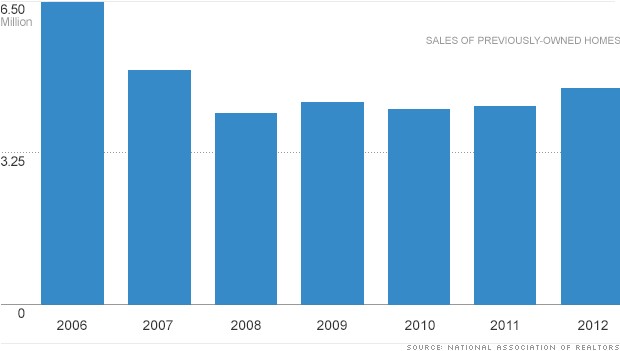
For 2012 as a whole, sales were up 9% to 4.65 million units, the highest annual total since 2007.
Prices, meanwhile, are picking up because the number of homes for sale continues to drop despite the sales volume gains. The number of homes for sale fell to 1.82 million at the end of 2012, an 8.5% drop from November and a 21.6% decline from one year earlier, the Realtors’ group said on Tuesday.
Here’s a breakdown of why inventory has continued to drop this year:
Many homeowners are underwater: More than 10 million homeowners owe more on their mortgage than their homes are worth, according to CoreLogic Inc. CLGX +0.61% That pencils out to around 22% of homeowners with a mortgage, or 15% of all homeowners (since not every homeowner has a mortgage). Underwater owners aren’t likely to sell unless they need to move due to changing life (marriage, divorce) or financial circumstances, and they’ll take a hit on their credit for pursuing a short sale, where the bank allows the home to sell for less than the amount owed.Data from CoreLogic show that inventory has been the most constrained in housing markets where there’s the largest concentration of underwater borrowers.
Others don’t have enough equity to “trade up”: Another 10 million homeowners have less than 20% equity in their current residence, meaning they can’t easily “trade up” to their

Tuesday, February 19, 2013

THE ECONOMY: Krugman Says Fed Low Rates Key to Housing Rebound: Tom Keene

Nobel Prize-winning economist Paul Krugman said the Federal Reserve must keep interest rates low to sustain the U.S. housing recovery.

“We have the beginnings of a housing recovery, it’s just starting to kick in,” the Princeton University economics professor said in an interview today on “Bloomberg Surveillance” with Tom Keene and Sara Eisen. “If the Fed were to raise rates, they would kill that.”

Central bank policy makers have said they will keep their benchmark lending rate near zero as long as unemployment remains above 6.5 percent and inflation is projected to be no more than 2.5 percent. U.S. unemployment rose to 7.9 percent in January, even as the economy added 157,000 jobs.

The housing market has been a bright spot in the economy, with housing starts rising 12.1 percent in December to cap the industry’s best year since 2008.

Krugman called the housing recovery the “best chance” the U.S. economy has to expand. The U.S. should have learned from Japan, which “repeatedly aborted its recovery by tightening too soon” during that nation’s own crisis.

The U.S. is already five years into a crisis that mirrors the Asian nation’s so-called “lost decade,” Krugman said. The period in the 1990s saw Japan’s economy slip in and out of recession and grow at an average rate of about 1 percent a year after the collapse of a real-estate bubble.

Like Japan
“We already are Japan-like, we’re worse than Japan ever was,” he said. “The human misery here is much worse than Japan has ever suffered.”

He said the U.S. needs to build infrastructure and that it is acceptable to pump money into the

Tuesday, February 12, 2013

THE ECONOMY: Big money betting big on housing

Hedge funds and private equity firms have been rushing in to buy up companies and assets in every part of the housing supply chain, including undeveloped land, homebuilders, foreclosed homes, and building parts manufacturers.

One of the most notable moves is coming from hedge fund manager John Paulson, best known for his big (and lucrative) bets against subprime mortgages in 2006 and 2007.

Now, he's turned his attention to snapping up undeveloped land in areas hardest hit by the housing crisis. "Land is the accordion in the home building equation," said Michael Barr, who runs Paulson's real estate investments. "It falls the most in a downturn, but also rises the most in an upturn."

Over the past two years, Paulson & Co has bought up enough land in California, Arizona and Nevada to build up to 25,000 homes and is aggressively scouting for more, according to Barr.

Private equity firms are also getting in on the game.
Blackstone Group (BX) spent $2.7 billion last year to buy 17,000 single family homes, post-foreclosure, around the United States and plans to continue ramping up those efforts in 2013.
Pine River Capital Management took real estate investment trust Silver Bay Realty Trust (SBY) public in December. Silver Bay, which acquires, renovates, leases and manages single family homes, has already purchased more than 2,500 homes in areas hard hit by the housing crisis. In a recent SEC filing, Silver Bay said that it plans to purchase 3,100 more homes.

And in a sign of investors' growing appetite for a piece of the housing market, shares of publicly traded homebuilders have been soaring. PulteGroup (PHM), KB Home (KBH), and Lennar (LEN) are all trading near 52-week highs. Pulte's shares have more than doubled over the past year, while the KB Home and Lennar's shares have nearly doubled.

And for the first time since 2004, homebuilders are testing the IPO waters.

Tri Pointe Homes (TPH), which builds single family homes in California and Colorado raised

Monday, February 11, 2013

MARKET TRENDS: Impacts Of The Improving Housing Market

A lot of people are clamoring about the improving housing market. Many wonder if we have really turned the corner and how much better it will get. Also, what impact will it make?

Chief economist, Anthony Chan, for private wealth management at J.P. Morgan in New York, as reported by Business Observer, said, "Things are getting better because housing is getting better."

The rising housing prices ignite a sense of confidence in the economy and lead to greater spending. What this means is that there is great opportunity for sellers.

One group in particular is the "boomerang buyers". That's the term being used for those homeowners who lost their home to a short sale or foreclosure in the recent past and now are shopping for another home to buy.

However, the guidelines for these buyers are strict. It's likely they have to have at least 20 percent deposit and wait at least two years after the foreclosure before they can buy again. It's unlikely that high-risk loans will be available to this group.

Sellers are noting the improving housing market and anticipating an even better year. Part of that is not only due to rising home prices but also less inventory. In December, 1.82 million homes were listed for sale according to the National Association of Realtors, down 22 percent from a year ago. The supply hasn't been this low since 2005.

This may seem like all good news, at least for sellers, but if home prices rise due to a

Saturday, February 9, 2013

MARKET TRENDS:L Prices are up, but homes are in short supply


The supply of homes for sale has been shrinking for six months and shows no improvement so far in January — a bad sign for buyers.
Listings of existing homes for sale were down 14% year-over-year in the first two weeks of January, according to Realtor.com, which tracks 146 markets nationwide.
In Phoenix, where prices were up 24% in November from a year earlier, new listings through the first three weeks of January hit their lowest level in 13 years, says Mike Orr, real estate expert at the W.P. Carey School of Business at Arizona State University.
That's bad news for buyers, and it means "prices need to go up more" to bring more sellers to market, Orr says.
Nationwide, the supply of existing homes for sale fell to 4.4 months in December, based on the current monthly sales pace, says the National Association of Realtors. That's the lowest level in more than seven years. A six-month supply is generally considered balanced between buyers and sellers.
Home prices in November were 7.4% higher on average than a year earlier, according to CoreLogic. Real estate experts had expected that rising prices would spur more sellers trapped by years of falling prices.
Instead, January's listing data "is the same sad story," says Glenn Kelman, CEO of online brokerage Redfin. If sellers don't have to sell, "they're holding on, thinking they'll wait for prices to go up even more."
Redfin's data, covering 19 major markets mostly in the West, shows new listings down 29% the first two weeks of January vs. last year.
Scarce sellers aren't the only driver of shrinking supplies. There are fewer distressed properties for sale. Foreclosure sales were down 7% through the first nine months of last year from the same period in 2011, RealtyTrac says.
Meanwhile, demand is up. Existing home sales were up 9.2% last year, NAR's preliminary data show. New-home sales rose almost 20% in 2012, the government

Friday, February 8, 2013

THE ECONOMY: Tech sector spurs Mass. growth as US economy contracts


No one is calling it a return to boom times, but the state’s economy grew modestly in the ­final three months of 2012, even as the US economy unexpectedly contracted slightly, the University of Massachusetts reported Wednesday.
The contrast offered further evidence the state is rebounding from the recession at a more robust pace than the nation as a whole, largely on the strength of its technology industries.
“This appears to be a slow quarter, but the Massachusetts economy is growing still,” said Alan Clayton-Matthews, a Northeastern University economist and author of the report. “And growth is going to pick up.”
The state’s economy grew at a 1 percent annual rate in the fourth quarter, while the Commerce Department said the US economy shrunk at an annual rate of one-tenth of a percent, largely because of a pullback in government spending.
The state growth rates were reported in MassBenchmarks, an economic journal published by UMass and the Federal Reserve Bank of Boston. The decline in US economic growth was the first contraction since the first half of 2009, according to the Commerce Department.Over all of 2012, the Massachusetts economy grew 2.1 percent, compared with 1.5 percent nationally, according to UMass. The state also put people back to work at a faster rate — employment grew by 1.6 percent last year, compared with 1.4 percent nationally. Those figures could change, however, as revisions to the data are made in coming weeks by statistical agencies.
The report put a damper on the recent rally in US stocks, which retreated from five-year highs. The Dow Jones industrial average fell 44 points, or 0.32 percent, to 13,910.42, while the broader Standard & Poor’s 500 index fell 5.88 points, or 0.39 percent, to 1,501.96. The technology heavy Nasdaq lost 11.35 points, or 0.36 percent, to close at 3,142.31.
Economists said the contraction was not the harbinger of another US recession. But Federal Reserve policy makers, meeting in Washington on Wednesday, acknowledged in a statement that the economy had slowed in recent months as a result of Hurricane Sandy and other temporary factors. The Fed said it would maintain its policies to stimulate the economy and keep long- and short-term interest rates low.
Still, the decline surprised many analysts, who had forecast that the national economy grew at the end of last year, albeit weakly. Uncertainty about whether Congress would avoid a scheduled combination of tax increases and deep spending cuts — and potential recession

Wednesday, February 6, 2013

MARKET TRENDS: Housing market strengthening in US, around Boston


Home values in the Boston area rose by 2.3 percent in November compared with the same month in 2011, according to data released Tuesday by the S&P/Case-Shiller Home Price Indices, which is widely considered a reliable measure of the housing market.
Nationwide, the improvement was more pronounced, with prices increasing by 5.5 percent in the 20 metropolitan areas tracked by Case-Shiller. Unlike some other housing barometers, the index is based on repeat home sales, which many industry analysts consider a more accurate way to gauge the market.
The numbers add to a growing bundle of economic news showing the country’s long-suffering housing industry is on the rebound.
David M. Blitzer, chairman of the index committee at the S&P Dow Jones Indices, said the increase in sales and values provides further evidence the housing market is helping to jump-start the US economy.
But Blizter cautioned US home values are not likely to continue to rise at such a brisk pace. Normally, he said, values rise a bit faster than the rate of inflation.
“We are on the rebound and at some point the rise in prices will flatten out a little bit,” he

Monday, February 4, 2013

MARKET TRENDS: 2012 home sales: Best in 5 years

Steady December home sales capped the best year for the U.S. real estate market in five years, according to an industry trade group report Tuesday.


The National Association of Realtors said that December sales of previously-owned homes came in just slightly below November's sales pace, but up 12.8% from a year ago. That brought full-year sales to 4.65 million, up 9% from 2011 and the best year for home sales since 2007, when there were 5 million homes sold just before the start of the recession.

Sales are being helped by a combination of strong market fundamentals -- near record low mortgage rates, lower unemployment and a rebound in home prices, all of which are bringing in buyers into the market who had been waiting for it to hit bottom. The mortgage rates and years of depressed home prices have also combined to create the most affordable housing market on record, according to the Realtors group.
And the Realtors are predicting strong sales should continue into 2013 and beyond. It has a

Sunday, February 3, 2013

MARKET TRENDS: How a New Housing Bubble Could Develop


Robert Shiller doesn’t see one on the horizon

WE’RE beginning to hear noises that we’ve reached a major turning point in the housing market — and that, with interest rates so low, this is a rare opportunity to buy. But are such observations on target?
It would be comforting if they were. Yet the unfortunate truth is that the tea leaves don’t clearly suggest any particular path for prices, either up or down.
My ultimate takeaway is much different. The leaves I see are ripe for a new bubble and I’ll continue to try to draw out that case. What’s interesting here, however, is how little Dr. Shiller and I disagree on the facts.
Shiller goes on:

After screening out these effects, a number of indicators are up, including data for housingstarts and permits as well as the National Association of Home Builders/Wells Fargo Indexof traffic of prospective homebuyers, which has made a spectacular rebound since last spring.
What might explain this picture? It’s hard to pin down, because nothing drastically different occurred in the economy from March to September. Yes, there was economic improvement: the unemployment rate, for example, dropped to 7.8 percent from 8.2 percent. But that extended a trend in place since 2009. There was also a decline in foreclosure activity, but for the most part that is also a continuing trend, as reported by RealtyTrac.
 Shiller and I agree that nothing drastically different occurred in the the economy from March to September. What I do think happened is that the housing market passed a critical point – similar to the notion of “tipping points”, popularized by Malcom Galdwell. 
Prior to the Winter of 2011/2012, weakness in the housing market was creating conditions which fostered further weakness in the housing market. During that winter we crossed a point where conditions in the housing market were fostering increased strength in the housing market.
The housing market and the larger economy were still subject external shocks including the debt ceiling debate, the European Crisis and unexpectedly strong austerity by State and Local governments.
However, the underlying conditions were still building on themselves.
Importantly, I tend to think of these conditions as being driven by financial interactions

Friday, February 1, 2013

MARKET TRENDS: U.S. home prices crawl upward


U.S. home prices continued to inch their way up, showing a 0.5% increase from October to November, according to the latest Lender Processing Services home price index.
Home prices grew 5.1% year-over-year, based on LPS’s analysis of homes in 15,500 ZIP codes.
The LPS HPI is a study of non-distressed home sales and discounts the influence of REO sales and short-sale transactions.
The average price for a home sold in the U.S. in November reached $207,000, dropping from a peak of $266,000 in June 2006, but up from $197,000 in November 2011.
The states that saw the greatest price appreciation in the report were Florida (prices up 1.5%); New York (prices up 1.1%); Washington D.C. (prices up 1.0%); and Georgia, Minnesota and Nevada (all up 0.9%).
Conversely, Rhode Island and Massachusetts both saw negative monthly movement, dipping 0.1% and 0.2%, respectively.
Individual metros that saw strong price gains included Chicago (prices up 0.7%), Dallas (prices up 0.3%), Los Angeles (prices up 0.8%), New York (prices up 1.0%) and Washington (prices up 0.5%).
Click on the table below to see the recent HPI changes.

Jonathon Weiner, vice president of research & development at LPS Applied Analytics believes the upward trajectory of home prices will continue throughout the year.
"Given the duration and strength of the recent upturn, and the absence of any obvious short term cause, it is probably related to a fundamental demand for housing," said Weiner. "While

Wednesday, January 30, 2013

MARKET TRENDS: Pending Home Sales Fall Due to Dwindling Supply

Signed contracts to buy existing homes fell 4.3 percent in December from the previous month, according to a monthly index from the National Association of Realtors. That missed analysts' expectations of a one percent gain. The index is 6.9 percent higher than December of 2011. Realtors say it is not lack of demand but supply at the end of 2012 that pushed the numbers down.

"Buyer interest remains solid, as evidenced by a separate Realtor survey which shows that buyer foot traffic is easily outpacing seller traffic," wrote Lawrence Yun, chief economist for the NAR in a release.

Much of last year's gains in existing home sales was driven by investor demand for foreclosures and other distressed properties. Millions of dollars, largely in cash, from private equity, flowed into the market, pushing supplies down dramatically and even causing bidding wars in some of the previously hardest hit markets. That pushed prices up in the double-digit range, but critics caution that this is not a real organic recovery in the overall market. These existing sales numbers as well as a disappointing read last week on sales of newly built homes are bolstering that warning.

The Realtors' monthly index fell 5.4 percent in the Northeast month-to-month, rose 0.9 percent in the Midwest, fell 4.5 percent in the South and fell 8.2 percent in the West. The West, and its severely distressed markets like Phoenix and Las Vegas, has been the center of most investor interest and is therefore seeing the lowest supply of properties for sale. The West is also the only region that saw a year-over-year decline in signed sales contracts in December.

Housing inventory usually drops in the winter months, only to rebound in the spring, but this winter has seen a larger than normal decline. Realtors are looking for more homes to come on the market in the spring, but there are still 10.7 million borrowers who owe more on their mortgages than their homes are worth, and an additional 2.3 million who have less than five percent equity in their homes, according to CoreLogic. Those homeowners cannot sell without having to pay into their mortgages, so they are largely stuck in place. First-time home buyers are purchasing at an unusually low rate due to tighter credit standards, and many potential sellers simply don't want to list until prices rise more substantially.

"We expect a seasonal rise of inventory in the spring to help, but a seller's market may be developing," notes Yun. "Much of the West is already a seller's market for homes priced under a million dollars, but conditions are much more balanced in the Northeast."

http://www.cnbc.com/id/100412357/Pending_Home_Sales_Fall_Due_to_Dwindling_Supply

Tuesday, January 29, 2013

THE ECONOMY: Housing to drive economic growth (finally!)

The bursting of the housing bubble plunged the economy into a recession from which it has yet to fully recover. But economists say this could finally be the year that housing lifts us out of the doldrums.

Just over half of economists surveyed by CNNMoney identified a housing recovery as the primary driver of economic growth this year. The rest were split fairly evenly between consumer spending, increased domestic energy production and stimulus from the Federal Reserve as major growth drivers.

"Homebuilding activity will likely remain the strongest growing component of the economy in 2013," said Keith Hembre, chief economist of Nuveen Asset Management. "After several years of excess supply, demand and supply conditions are now in much better balance."

Home sales rebounded to the strongest level in five years in 2012, as home building bounced back to levels not seen since early in the recession. Near record low mortgage rates, rising home prices and a drop in foreclosures have combined to bring buyers back to the market.
The economists surveyed also forecast that there will be just under 1 million housing starts this year -- roughly matching the 28% rise in home building in 2012. Moody's Analytics is forecasting much stronger growth -- a 50% rise both this year and next year, which it estimates will create more than 1 million new jobs.

"There's a lot of pent-up demand for housing, and very little supply," said Celia Chen, housing economist for Moody's Analytics. "As demand continues to improve, home builders have nothing to sell. They'll have to build." She said that growth in building will mean adding not just construction jobs, but also manufacturing jobs building the appliances and furniture needed in the new homes, which in turn drives overall consumption higher.

And economists say the tight supply and renewed demand for housing should lead to higher

Monday, January 28, 2013

THE ECONOMY: New-home sales post first annual gain in 7 years


Sales of new single-family homes rose 19.9 percent from 2011 to 2012, with 367,000 newly-built homes sold last year, the U.S. Census Bureau reported today.
It's been seven years since new-home sales posted an annual gain, but 2012 was still the third worst year in Census Bureau records dating to 1963, blogger Bill McBride noted onCalculated Risk. The two worst years for new-home sales were 2010 and 2011.
The Census Bureau also reported that after an upward revision of November's numbers, the annual rate of new-home sales dropped 7.3 percent from November to December, to a seasonally adjusted 369,000 per year.
That represents an 8.8 percent increase from a year ago.
The median sales price of new homes sold in December was $248,900, up 9.6 percent from a year ago and 1.3 percent from November.
The Census Bureau estimated that 151,000 new homes were on the market at the end of December, representing a 4.9-month supply.
Annual new-home sales
YearSales (thousands)Percent change in sales
2005
1,283
6.7%
2006
1,051
-18.1%
2007
776
-26.2%
2008
485
-37.5%
2009
375
-22.7%
2010
323
-13.9%
2011
306
-5.3%
2012
367
19.9%
McBride said he expects December sales will be upwardly revised, just as those for the three previous months have been. In the years to come, McBride and others expect sales of new single-family home sales will be much higher.
"My guess is sales will rise to around 800,000 per year in a few years, but others think the next

Friday, January 25, 2013

THE ECONOMY: Mass. single-family home prices rose 18% last year

In another sign that the housing market may be on the mend, the median sale price of single-family homes in Massachusetts rose more than 12 percent in December to $300,000, the first time since August that median home prices have broken the $300,000 mark, the Warren Group said Thursday.

Looking at the entire year, the Warren Group added that single-family home sales in Massachusetts rose 18 percent in 2012, marking 12 consecutive months of year-over-year sales gains and the best year on record since 2006.

“I would characterize 2012 as the year of robust recovery in the real estate market,” Warren Group chief executive Timothy M. Warren Jr. said in a statement. “It is clear we have turned the corner and are gaining ground rapidly. I contrast the 18 percent gain last year with the decline of 6 percent in 2011.”

As for condo sales in December, they rose 5.4 percent to 1,402 units. The median condo price in December rose 8 percent to $275,000, the Warren Group said.

For 2012, condo sales were up more than 25 percent to 19,061 units.

The Massachusetts Association of Realtors issued a separate monthly report Thursday on the local housing market. The association uses a slightly different method to track real estate activity than the Warren Group does.

According to the association’s press release, 3,737 detached single-family homes sold in December, a 13 percent increase from the previous December. December 2012 was the 18th straight month of year-over-year increases.

The median selling price for single-family home in December was $303,500, which was up