Book Review
Title: "Shift Your Habit: Easy Ways to Save Money, Simplify Your Life and Save the Planet"
Author: Elizabeth Rogers, with Colleen Howell
Publisher: Three Rivers Press, March 2010; 288 pages; $14
In my personal life (which, by the way, has about 80 percent overlap with my business life), I'm making a constant effort to evolve into a greener and greener life. I used to call myself "light green," meaning I drove my big old luxury SUV down the street to Whole Foods, all by my lonesome and on a regular basis.
If I had options, I'd choose the green one -- as long as it was no less convenient than the guzzly, "regular" way. Over the last few years, though, I've just started to, uh, give more of a crap about our planet. And I've found that oftentimes the green way to do things has turned out to be less costly as well. Bonus!
So, it was a surprise to me when, during a recent conversation about implementing some additional green living features in my home, a colleague exclaimed that he never bothered trying to green his home because it was just too expensive. What a difference a perspective-shift makes.
I was planning on building a recycling center and a compost area -- at negligible cost for the green and organizational upsides. He assumed that unless you were installing $20,000 worth of new dual-paned windows, you were out of luck in terms of greening your home.
Clearly, Elizabeth Rogers' new book, "Shift Your Habit: Easy Ways to Save Money, Simplify Your Life and Save the Planet," is overdue! Not only does it come just in time for my colleague, but also just in time for the many Americans who are currently undergoing perspective, mindset and habit shifts toward both economical and ecological conservation and sustainability.
In "Shift Your Habit," Rogers not only offers recommendations to readers -- she actually took them on the road, and worked with families coast to coast to implement at least 15 of what she calls "Super Shifts" per family, to provide case studies and reality-based money-savings estimates throughout the book. She defines these Super Shifts as "easy to incorporate," "universally relevant changes that would ... provide instant environmental and economic impact."
Exhibiting just how powerful she believes the Super Shifts are, Rogers sticks them right at the beginning of the book -- a powerful two-page numbered list of easy little tweaks to living, along with how much a household can save by making the change. Water filter on the tap -- almost $900 per year in bottled water savings. Yep -- meaty money savings, with a side order of do-goodism.
Outside of the "Meet the Shifters" features in each chapter, where Rogers tells the story of a family who implemented 15 of her Shifts, "Shift Your Habit" reads primarily as a collection of lists -- lists of well-organized small changes that save money and energy or water, reuse or eliminate waste or otherwise implement green values.
Beginning with Home and Garden, Rogers offers tips around lighting, space and water conditioning (heating and cooling), cleaning and tips for every room of the home -- from kitchen to bedrooms. She also offers useful charts illustrating the savings that can be had from various efficient appliances and recipes for homemade, organic cleaning products, before moving to exterior landscaping, pool area efficiencies and edible gardening. All told, Rogers estimates her shifts can save a household nearly $6,000 per year -- nothing to sneeze at.
From there, Rogers forays into green, money-saving strategies for eating and drinking both at home and in restaurants. My favorite: the section on extending the life of produce and other perishable foods. Savings? Over $9,000 for an average family, according to Rogers! Next? Kids and Pets -- Rogers educates readers as to how they can conserve cash and energy, while still feeding, clothing, educating and entertaining their children of all ages, furry and otherwise.
"Shift Your Habit" then covers how those who live green at home can live those values out at work, where they actually spend more of their time. From work to play, the book then shifts its attention to Electronics and Entertainment; Health, Beauty and Fashion; Transportation and Travel and Holidays and Celebrations. Throughout, Rogers offers helpful charts, tips, lists, savings estimates and anecdotes from her "shifter" families.
If you've been operating under the impression that living green requires a massive up-front investment of either time or money, "Shift Your Habit" is the perfect way to correct that misunderstanding and do your part for the earth and your own finances, at little or no cost.
Tara-Nicholle Nelson Inman News Nobember 8, 2010
Showing posts with label Book Review. Show all posts
Showing posts with label Book Review. Show all posts
Tuesday, November 23, 2010

Tuesday, November 9, 2010
BOOK REVIEW: "Spend Shift", A cure for overconsumption.
Book Review
Title: "Spend Shift: How the Post-Crisis Values Revolution is Changing the Way we Buy, Sell and Live"
Authors: John Gerzema and Michael D'Antonio
Publisher: Jossey-Bass, 2010; 288 pages; $25.95
Is there such a thing as a "triple entendre"? If so, the word "consumption" would pose one. An outdated definition of consumption is truly a disease, the colloquialism for tuberculosis around the time my great-grandmother succumbed to it in the early 1950s.
On the other hand, the two other meanings that come to mind for me are quite "au courant" (French for "up-to-date"): one implying the intake of food, the other implying purchasing behaviors and patterns.
It is the latter of these three meanings which serves as the subject of "Spend Shift: How the Post-Crisis Values Revolution is Changing the Way we Buy, Sell and Live," by consumerism expert John Gerzema and Pulitzer-Prize winner Michael D'Antonio.
More precisely, "Spend Shift" focuses on insights into how all sorts of American people and businesses have radically revised their values, their spending behavior and their companies' practices and offerings in the wake of the recession. The authors gleaned these insights two ways: via an extensive, longitudinal study into Americans' buying behavior which Gerzema runs, and on a post-bubble, coast-to-coast road trip.
The Introduction, Numbers and Their Meaning, drills down into a number of metrics quantifying the damage "The Great Recession" has wreaked on the American economy, and how many Americans qualify as Spend Shifters, defined by Gerzema and D'Antonio as "people who, in reacting to crisis, have subtly adjusted their lives to seek greater balance and a more fulfilling existence."
The authors go on to explore the values shared by these Spend Shifters -- who do make up the majority of Americans -- and how they break down generationally and in terms of their post-recession behavioral shifts. The authors end the chapter acknowledging that these numbers can only do so much in terms of illuminating this Spend Shift, and launch from there into a retelling of their road trip and real-world stories of real-life Spend Shifters.
Chapter One, The New American Frontier: Detroit, Mich., introduces readers to a few amazing small business owners who are pioneering a new economy and community in the otherwise "apocalyptic," economically destitute landscape of Detroit.
Title: "Spend Shift: How the Post-Crisis Values Revolution is Changing the Way we Buy, Sell and Live"
Authors: John Gerzema and Michael D'Antonio
Publisher: Jossey-Bass, 2010; 288 pages; $25.95
Is there such a thing as a "triple entendre"? If so, the word "consumption" would pose one. An outdated definition of consumption is truly a disease, the colloquialism for tuberculosis around the time my great-grandmother succumbed to it in the early 1950s.
On the other hand, the two other meanings that come to mind for me are quite "au courant" (French for "up-to-date"): one implying the intake of food, the other implying purchasing behaviors and patterns.
It is the latter of these three meanings which serves as the subject of "Spend Shift: How the Post-Crisis Values Revolution is Changing the Way we Buy, Sell and Live," by consumerism expert John Gerzema and Pulitzer-Prize winner Michael D'Antonio.
More precisely, "Spend Shift" focuses on insights into how all sorts of American people and businesses have radically revised their values, their spending behavior and their companies' practices and offerings in the wake of the recession. The authors gleaned these insights two ways: via an extensive, longitudinal study into Americans' buying behavior which Gerzema runs, and on a post-bubble, coast-to-coast road trip.
The Introduction, Numbers and Their Meaning, drills down into a number of metrics quantifying the damage "The Great Recession" has wreaked on the American economy, and how many Americans qualify as Spend Shifters, defined by Gerzema and D'Antonio as "people who, in reacting to crisis, have subtly adjusted their lives to seek greater balance and a more fulfilling existence."
The authors go on to explore the values shared by these Spend Shifters -- who do make up the majority of Americans -- and how they break down generationally and in terms of their post-recession behavioral shifts. The authors end the chapter acknowledging that these numbers can only do so much in terms of illuminating this Spend Shift, and launch from there into a retelling of their road trip and real-world stories of real-life Spend Shifters.
Chapter One, The New American Frontier: Detroit, Mich., introduces readers to a few amazing small business owners who are pioneering a new economy and community in the otherwise "apocalyptic," economically destitute landscape of Detroit.
Tuesday, November 2, 2010
BOOK REVIEW: Cracking the code on home finance
Book Review
Title: "The Mortgage Encyclopedia: The Authoritative Guide to Mortgage Programs, Practices, Prices and Pitfalls (Second Edition)"
Author: Jack Guttentag
Publisher: McGraw-Hill, 2010; 352 pages; $24.95
If ever there was a time America needed a mortgage professor, that time would be now. In the subprime days, consumers needed mortgage education, but they didn't know it, because it was so easy to achieve their overarching aim of qualifying for a home loan.
Now, not only is it much more difficult to qualify for a mortgage, the average American's mortgage goals center more around making the best decision, selecting the best mortgage for their lives, and, ultimately, scoring the best mortgage deal, than simply taking any mortgage that comes their way.
To feed America's next-generation mortgage education needs, enter Jack Guttentag, professor of finance emeritus at Wharton (and also a columnist for this column's syndicator, Inman News), with the second edition of his book, "The Mortgage Encyclopedia: The Authoritative Guide to Mortgage Programs, Practices, Prices and Pitfalls."
Guttentag, known as the "Mortgage Professor" for decades, has added 100 terms to this latest edition of his book that specifically address the latest developments in the mortgage market.
"The Mortgage Encyclopedia" is certainly a handy reference guide, but bits and pieces of it are readable and useful more in the vein of a primer and decision guide than an occasional reference.
Specifically, the sections on interest-rate locking, refinancing and the various loan program types (from adjustable-rate mortgages to reverse mortgages) are highly detailed yet user-friendly briefings on these topics, not only defining them but also delving into the decision points, pros and cons that mortgage consumers need to know about.
The section on lease-to-own arrangements, not even a mortgage topic in the strict sense, offers a great example of Guttentag's evolution of the encyclopedia format into something much more worthwhile for consumers than a traditional reference-only guide.
The Mortgage Professor first, as with every entry, offers a very basic, plain-English definition of a lease-to-own arrangement: a "transaction in which a hopeful homeowner-to-be leases a home with an option to buy it within a specified period at an agreed-upon price."
He then goes on to break down the essential provisions of a lease-purchase contract, and defines each of them in detail, offering examples of the trade-offs and possibilities for how each element can be structured.
Before wrapping this section up, Guttentag explores the various scenarios in which lease-options are used by both buyers and sellers and briefs readers on potential "Dangers to Buyers." It's a fairly thorough treatment of such a confusion-engendering topic, all in a couple of pages.
"The Mortgage Encyclopedia" would be an ideal buy for homeowners and wannabe homeowners at virtually any stage in the homeownership lifecycle.
Those in the process of even thinking about and planning for buying a home will find it extremely informative and empowering at deciphering the alphabet soup of mortgage jargon they will inevitably face while seeking to understand how much mortgage and home they can qualify for, and what cash they will need to come up with to close the deal and maintain their mortgage obligations going forward.
Due to today's lenders' tight lending guidelines, acronyms ranging from LTV (loan-to-value ratio) to DTI (debt-to-income ratio) will have a fairly dramatic impact on the eventual homes, finances and lifestyles of today's homebuyer-to-be, and Guttentag offers clarity on these critical concepts.
However, this book is at least as useful -- maybe more -- for current homeowners. Last week, the big mortgage news story was that the interest rate on a 30-year-fixed rate mortgage was 4.45 percent -- the lowest it's been since 1953, as long as the government has been tracking this metric.
And that's not all. Get this: In 2007, only 1 in 10 refinancing homeowners chose a 15-year fixed-rate loan; so far in 2010, 1 in 4 refinanced into a 15-year fixed vs. a 30-year loan, according to mortgage data company CoreLogic.
With all the refinancing, (attempted) loan modifying, short-selling and even walking away that's going on around the country right now, it seems to me that this is precisely the right time for "The Mortgage Encyclopedia."
Tara-Nicholle Nelson Inman News October 19, 2010
Title: "The Mortgage Encyclopedia: The Authoritative Guide to Mortgage Programs, Practices, Prices and Pitfalls (Second Edition)"
Author: Jack Guttentag
Publisher: McGraw-Hill, 2010; 352 pages; $24.95
If ever there was a time America needed a mortgage professor, that time would be now. In the subprime days, consumers needed mortgage education, but they didn't know it, because it was so easy to achieve their overarching aim of qualifying for a home loan.
Now, not only is it much more difficult to qualify for a mortgage, the average American's mortgage goals center more around making the best decision, selecting the best mortgage for their lives, and, ultimately, scoring the best mortgage deal, than simply taking any mortgage that comes their way.
To feed America's next-generation mortgage education needs, enter Jack Guttentag, professor of finance emeritus at Wharton (and also a columnist for this column's syndicator, Inman News), with the second edition of his book, "The Mortgage Encyclopedia: The Authoritative Guide to Mortgage Programs, Practices, Prices and Pitfalls."
Guttentag, known as the "Mortgage Professor" for decades, has added 100 terms to this latest edition of his book that specifically address the latest developments in the mortgage market.
"The Mortgage Encyclopedia" is certainly a handy reference guide, but bits and pieces of it are readable and useful more in the vein of a primer and decision guide than an occasional reference.
Specifically, the sections on interest-rate locking, refinancing and the various loan program types (from adjustable-rate mortgages to reverse mortgages) are highly detailed yet user-friendly briefings on these topics, not only defining them but also delving into the decision points, pros and cons that mortgage consumers need to know about.
The section on lease-to-own arrangements, not even a mortgage topic in the strict sense, offers a great example of Guttentag's evolution of the encyclopedia format into something much more worthwhile for consumers than a traditional reference-only guide.
The Mortgage Professor first, as with every entry, offers a very basic, plain-English definition of a lease-to-own arrangement: a "transaction in which a hopeful homeowner-to-be leases a home with an option to buy it within a specified period at an agreed-upon price."
He then goes on to break down the essential provisions of a lease-purchase contract, and defines each of them in detail, offering examples of the trade-offs and possibilities for how each element can be structured.
Before wrapping this section up, Guttentag explores the various scenarios in which lease-options are used by both buyers and sellers and briefs readers on potential "Dangers to Buyers." It's a fairly thorough treatment of such a confusion-engendering topic, all in a couple of pages.
"The Mortgage Encyclopedia" would be an ideal buy for homeowners and wannabe homeowners at virtually any stage in the homeownership lifecycle.
Those in the process of even thinking about and planning for buying a home will find it extremely informative and empowering at deciphering the alphabet soup of mortgage jargon they will inevitably face while seeking to understand how much mortgage and home they can qualify for, and what cash they will need to come up with to close the deal and maintain their mortgage obligations going forward.
Due to today's lenders' tight lending guidelines, acronyms ranging from LTV (loan-to-value ratio) to DTI (debt-to-income ratio) will have a fairly dramatic impact on the eventual homes, finances and lifestyles of today's homebuyer-to-be, and Guttentag offers clarity on these critical concepts.
However, this book is at least as useful -- maybe more -- for current homeowners. Last week, the big mortgage news story was that the interest rate on a 30-year-fixed rate mortgage was 4.45 percent -- the lowest it's been since 1953, as long as the government has been tracking this metric.
And that's not all. Get this: In 2007, only 1 in 10 refinancing homeowners chose a 15-year fixed-rate loan; so far in 2010, 1 in 4 refinanced into a 15-year fixed vs. a 30-year loan, according to mortgage data company CoreLogic.
With all the refinancing, (attempted) loan modifying, short-selling and even walking away that's going on around the country right now, it seems to me that this is precisely the right time for "The Mortgage Encyclopedia."
Tara-Nicholle Nelson Inman News October 19, 2010
Saturday, September 18, 2010
BOOK REVIEW: 8 tips to survive a career disaster
Book Review
Title: "Harvard Business Review on Managing Your Career in Tough Times"
Authors: Various
Publisher: Harvard Business Press, 2010; 192 pages; $22
I don't normally review "job" books. Real estate and person finance tend to define the boundaries of my book review wheelhouse.
But after poring over all the astonishingly negative real estate data that came out a couple of weeks ago (15-year-low monthly existing-home sales rate! 11-year-high inventory! lowest rate of new-home sales since -- wait for it -- 1963!!), I've become increasingly convinced that the fortunes of the job market and the real estate market are inextricably intertwined.
And, like the housing market, I've seen the recent job market drama and trauma so up close and personal I can no longer pooh-pooh unemployment reports as overblown, or simply not applicable to people like me. I know attorneys who are out of work, among many other educated, professional, did-it-all-right folks who are struggling to keep their heads -- and incomes -- above water.
And beyond that, I know dozens of people who fall into the category of underemployed, working less-than-desirable freelance gigs, part-time jobs and even full-time jobs for which they are decidedly overqualified, so their personal career crises aren't even receiving the dignity of a tally mark on the government rolls -- they don't even rate to be discussed in news reports of the crisis.
The Bureau of Labor Statistics says the current unemployment rate is 9.6 percent; the most recent Gallup poll says that on top of this, about another 9 percent of Americans are underemployed.
Enter the Harvard Business Review, with a very real-world applicable volume of their Ideas with Impact series, "Managing Your Career in Tough Times." A compendium of eight essays, which all originally appeared in the monthly Harvard Business Review, many of these offer very fresh and expert perspectives on being strategic, staying employed (or surviving unemployment) and growing your mindset, leadership skills and career in today's recessionary and fast-changing corporate climate.
Each article is brief; the first, How to Protect Your Job in a Recession, presents readers with 10 pages of action steps ranging from the demeanor you should maintain to the actual changes you should make to the substance of your work during a soft economy.
Title: "Harvard Business Review on Managing Your Career in Tough Times"
Authors: Various
Publisher: Harvard Business Press, 2010; 192 pages; $22
I don't normally review "job" books. Real estate and person finance tend to define the boundaries of my book review wheelhouse.
But after poring over all the astonishingly negative real estate data that came out a couple of weeks ago (15-year-low monthly existing-home sales rate! 11-year-high inventory! lowest rate of new-home sales since -- wait for it -- 1963!!), I've become increasingly convinced that the fortunes of the job market and the real estate market are inextricably intertwined.
And, like the housing market, I've seen the recent job market drama and trauma so up close and personal I can no longer pooh-pooh unemployment reports as overblown, or simply not applicable to people like me. I know attorneys who are out of work, among many other educated, professional, did-it-all-right folks who are struggling to keep their heads -- and incomes -- above water.
And beyond that, I know dozens of people who fall into the category of underemployed, working less-than-desirable freelance gigs, part-time jobs and even full-time jobs for which they are decidedly overqualified, so their personal career crises aren't even receiving the dignity of a tally mark on the government rolls -- they don't even rate to be discussed in news reports of the crisis.
The Bureau of Labor Statistics says the current unemployment rate is 9.6 percent; the most recent Gallup poll says that on top of this, about another 9 percent of Americans are underemployed.
Enter the Harvard Business Review, with a very real-world applicable volume of their Ideas with Impact series, "Managing Your Career in Tough Times." A compendium of eight essays, which all originally appeared in the monthly Harvard Business Review, many of these offer very fresh and expert perspectives on being strategic, staying employed (or surviving unemployment) and growing your mindset, leadership skills and career in today's recessionary and fast-changing corporate climate.
Each article is brief; the first, How to Protect Your Job in a Recession, presents readers with 10 pages of action steps ranging from the demeanor you should maintain to the actual changes you should make to the substance of your work during a soft economy.
Saturday, August 14, 2010
BOOK REVIEW:
Title: "Mortgage Confidential: What You Need to Know That Your Lender Won't Tell You" (Second Edition)
Author: David Reed
Publisher: AMACOM, 2010; 233 pages; $17.95
The phrase "knowledge is power" was long ago taken way beyond its logical extreme. Fact is, when it comes to matters of money and, specifically, mortgage, too much knowledge for its own sake can be overwhelming and impair decision-making, rather than empowering wise decisions.
My experience has been that homeowners who spend too much of their mortgage education bandwidth trying to understand the complexities and inner workings of the wholesale mortgage securities market are inspired to pay the bankers back for their sinister dealings and rage against the Wall Street machine.
On the other extreme, there are some key, oft-ignored need-to-knows that can and do empower homebuyers and homeowners to make strategic and smart mortgage decisions.
David Reed, in his book "Mortgage Confidential: What You Need to Know That Your Lender Won't Tell You," makes it his personal mission to disseminate these need-to-knows and use them to direct the actual mortgage choices that real-world consumers are faced with making in their real lives.
This book's province is not everything about mortgages -- it's only what you need to know.
That simple mission is carried through in the simple style and tone of "Mortgage Confidential." Inside, it comes off as less us vs. them than one might guess from the title, and much more plain-talking, straight-shooting education, plus what to do with the knowledge.
Reed starts off covering where mortgage loans really come from, with a chapter full of myth-busting about banks, brokers, how loans are bought and sold, and by whom, plus what that means to you, the consumer: Odds Are, Your Mortgage Will Be Sold.
But where Reed excels is in having a deep knowledge of how things that consumers find irritating, like having their mortgage sold from one lender to another, can also ultimately help them: "the very fact that your loan can be sold in the first place yields a greater benefit: lower rates."
Reed is all about the nuance -- not the reactive, faux-pro-consumer outrage at the petty inconveniences and potential crookedness of some mortgage industry workings, but sharing the deeper insights at how sometimes things that seem to be against a borrower's best interests actually work in their favor overall, and vice versa.
He doesn't devote the whole book to plumbing the depths of the mortgage marketplace, but he does seem very familiar with them, so that he can share these insights and help readers understand what lies beneath the surface motivations of bank, broker, lender and beyond.
Reed goes on to cover the mortgage loan process, risk factors, closing costs, interest rates, choosing and refinancing mortgage loans, and obtaining a mortgage to buy or build a new home.
And along the way, he answers abundantly relevant questions that people you and I know are faced with every single day, like how to get the lowest mortgage rates, how to use the new disclosure laws to negotiate lower loan fees, and how to refinance your home when its value has dropped. (Who doesn't know someone seeking the answer to that last question?)
If you have mortgage questions, or are making mortgage decisions but are overwhelmed by all the irrelevant mortgage information out there, consider tapping into the need-to-knows in "Mortgage Confidential" -- it will save you time, and maybe preserve some of your sanity, in the process.
Tara-Nicholle Nelson Inman News August 3, 2010
Author: David Reed
Publisher: AMACOM, 2010; 233 pages; $17.95
The phrase "knowledge is power" was long ago taken way beyond its logical extreme. Fact is, when it comes to matters of money and, specifically, mortgage, too much knowledge for its own sake can be overwhelming and impair decision-making, rather than empowering wise decisions.
My experience has been that homeowners who spend too much of their mortgage education bandwidth trying to understand the complexities and inner workings of the wholesale mortgage securities market are inspired to pay the bankers back for their sinister dealings and rage against the Wall Street machine.
On the other extreme, there are some key, oft-ignored need-to-knows that can and do empower homebuyers and homeowners to make strategic and smart mortgage decisions.
David Reed, in his book "Mortgage Confidential: What You Need to Know That Your Lender Won't Tell You," makes it his personal mission to disseminate these need-to-knows and use them to direct the actual mortgage choices that real-world consumers are faced with making in their real lives.
This book's province is not everything about mortgages -- it's only what you need to know.
That simple mission is carried through in the simple style and tone of "Mortgage Confidential." Inside, it comes off as less us vs. them than one might guess from the title, and much more plain-talking, straight-shooting education, plus what to do with the knowledge.
Reed starts off covering where mortgage loans really come from, with a chapter full of myth-busting about banks, brokers, how loans are bought and sold, and by whom, plus what that means to you, the consumer: Odds Are, Your Mortgage Will Be Sold.
But where Reed excels is in having a deep knowledge of how things that consumers find irritating, like having their mortgage sold from one lender to another, can also ultimately help them: "the very fact that your loan can be sold in the first place yields a greater benefit: lower rates."
Reed is all about the nuance -- not the reactive, faux-pro-consumer outrage at the petty inconveniences and potential crookedness of some mortgage industry workings, but sharing the deeper insights at how sometimes things that seem to be against a borrower's best interests actually work in their favor overall, and vice versa.
He doesn't devote the whole book to plumbing the depths of the mortgage marketplace, but he does seem very familiar with them, so that he can share these insights and help readers understand what lies beneath the surface motivations of bank, broker, lender and beyond.
Reed goes on to cover the mortgage loan process, risk factors, closing costs, interest rates, choosing and refinancing mortgage loans, and obtaining a mortgage to buy or build a new home.
And along the way, he answers abundantly relevant questions that people you and I know are faced with every single day, like how to get the lowest mortgage rates, how to use the new disclosure laws to negotiate lower loan fees, and how to refinance your home when its value has dropped. (Who doesn't know someone seeking the answer to that last question?)
If you have mortgage questions, or are making mortgage decisions but are overwhelmed by all the irrelevant mortgage information out there, consider tapping into the need-to-knows in "Mortgage Confidential" -- it will save you time, and maybe preserve some of your sanity, in the process.
Tara-Nicholle Nelson Inman News August 3, 2010
Tuesday, July 13, 2010
BOOK REVIEW: 'Buying a Home: The Missing Manual'
Homeownership deconstructed
Book Review
Title: "Buying a Home: The Missing Manual"
Author: Nancy Connor
Publisher: O'Reilly, 2010; 352 pages; $21.99
 As far as provocative titles go, "Buying a Home: The Missing Manual" may not ooze "avant garde" at first glance. But if you, like me, keep tabs on the ever-increasing booklist of real estate titles, you might, like me, feel that to describe any book on homebuying as "the missing" one is to create some pretty big expectations.
If the title initially sparked my skepticism, it was only stoked by the cover's short description of the author as a "real estate pro," juxtaposed against its long description of her background as a real estate investor who is "qualified" for a New York real estate license, and has written other books on Google and living "green." All of these things sounded a warning bleep for me, even before I could open the cover.
However, I was aware that "The Missing Manual" series was the brainchild of David Pogue, a New York Times columnist who I follow, and whom I particularly admire as a polymath -- in other words, a guy who knows a whole lot of stuff about a whole lot of stuff.
So, I tried hard to keep an open mind about how much expertise this "pro" could possibly impart to readers on the subject of buying a home.
So I did -- and was pleasantly surprised, for the most part. The fact is, homebuyers -- and especially first-timers -- speak plain English, not always the same language spoken by those who can accurately claim themselves to be bona fide real estate experts.
I don't know that I'd say "Buying a Home: The Missing Manual" is revolutionary in the content it covers, or in any other respect, really. But it is a very accessible, very complete, concise and usable specimen of the how-to real estate genre -- and one that is written in a simple, accurate voice that users will appreciate.
Book Review
Title: "Buying a Home: The Missing Manual"
Author: Nancy Connor
Publisher: O'Reilly, 2010; 352 pages; $21.99
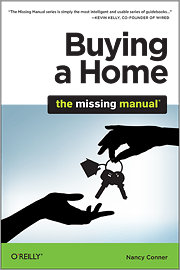
If the title initially sparked my skepticism, it was only stoked by the cover's short description of the author as a "real estate pro," juxtaposed against its long description of her background as a real estate investor who is "qualified" for a New York real estate license, and has written other books on Google and living "green." All of these things sounded a warning bleep for me, even before I could open the cover.
However, I was aware that "The Missing Manual" series was the brainchild of David Pogue, a New York Times columnist who I follow, and whom I particularly admire as a polymath -- in other words, a guy who knows a whole lot of stuff about a whole lot of stuff.
So, I tried hard to keep an open mind about how much expertise this "pro" could possibly impart to readers on the subject of buying a home.
So I did -- and was pleasantly surprised, for the most part. The fact is, homebuyers -- and especially first-timers -- speak plain English, not always the same language spoken by those who can accurately claim themselves to be bona fide real estate experts.
I don't know that I'd say "Buying a Home: The Missing Manual" is revolutionary in the content it covers, or in any other respect, really. But it is a very accessible, very complete, concise and usable specimen of the how-to real estate genre -- and one that is written in a simple, accurate voice that users will appreciate.
Monday, May 24, 2010
BOOK REVIEW: Learn the 'new rules' of real estate
Book Review
Title: "Buy, Close, Move In! How to Navigate the New World of Real Estate -- Safely and Profitably -- and End Up with the Home of your Dreams"
Author: Ilyce Glink
Publisher: Harper, 2010; 304 pages; $14.99
All of a sudden, real estate has gone from the "milquetoastiest" of finance topics to the most controversial, or nearly so. Every other person you meet has an opinion about what happened, how we got here, whose fault it is and what the future holds. This transformation, this sea change, has spawned a new sub-genre of real estate books: the "new rules" book.
Titles about new rules are, frankly, no longer new. But most treat the subject in a fairly academic way, which is no longer useful. To correct this problem, real estate journalist Ilyce Glink has authored a very consumer-friendly entry to the "new rules" genre: "Buy, Close, Move In! How to Navigate the New World of Real Estate -- Safely and Profitably -- and End Up with the Home of your Dreams."
Glink, a well-known journalist specializing in real estate, credit cards and personal finance matters, introduces the book with a breakdown of the digital transformation of real estate over the last 20 years or so -- from the digitization of old-school multiple listing service printed books, which brought listing information to the people, to Craigslist.
After covering the digital divide, Glink transitions into the credit crisis, the housing crisis and mortgage fraud, providing a summation of events that nicely lays the framework for lay readers to understand the New World of Real Estate she sets forth in the rest of the book.
Glink closes her intro with a key point, the third element of this new real estate geography in which we all live: the evolution of buyers into savvy, 2.0-trained, research-focused house hunters who crave information and know how to get it online.
After the first chapter, "Ten Things That Have Changed in Real Estate, Ten Things That Haven't," which focuses on some high-level general observations about how the industry changes and constants -- Glink moves into practical need-to-knows and actionable advisories for real estate consumers, driven by the changes in the industry.
In Chapter 2, "What Buyers Need to Know Now," Glink gives a brief but power-packed compare-and-contrast overview of the old standard rules of residential real estate versus the new rules for buying a home.
Title: "Buy, Close, Move In! How to Navigate the New World of Real Estate -- Safely and Profitably -- and End Up with the Home of your Dreams"
Author: Ilyce Glink
Publisher: Harper, 2010; 304 pages; $14.99
All of a sudden, real estate has gone from the "milquetoastiest" of finance topics to the most controversial, or nearly so. Every other person you meet has an opinion about what happened, how we got here, whose fault it is and what the future holds. This transformation, this sea change, has spawned a new sub-genre of real estate books: the "new rules" book.
Titles about new rules are, frankly, no longer new. But most treat the subject in a fairly academic way, which is no longer useful. To correct this problem, real estate journalist Ilyce Glink has authored a very consumer-friendly entry to the "new rules" genre: "Buy, Close, Move In! How to Navigate the New World of Real Estate -- Safely and Profitably -- and End Up with the Home of your Dreams."
Glink, a well-known journalist specializing in real estate, credit cards and personal finance matters, introduces the book with a breakdown of the digital transformation of real estate over the last 20 years or so -- from the digitization of old-school multiple listing service printed books, which brought listing information to the people, to Craigslist.
After covering the digital divide, Glink transitions into the credit crisis, the housing crisis and mortgage fraud, providing a summation of events that nicely lays the framework for lay readers to understand the New World of Real Estate she sets forth in the rest of the book.
Glink closes her intro with a key point, the third element of this new real estate geography in which we all live: the evolution of buyers into savvy, 2.0-trained, research-focused house hunters who crave information and know how to get it online.
After the first chapter, "Ten Things That Have Changed in Real Estate, Ten Things That Haven't," which focuses on some high-level general observations about how the industry changes and constants -- Glink moves into practical need-to-knows and actionable advisories for real estate consumers, driven by the changes in the industry.
In Chapter 2, "What Buyers Need to Know Now," Glink gives a brief but power-packed compare-and-contrast overview of the old standard rules of residential real estate versus the new rules for buying a home.
Tuesday, May 4, 2010
BOOK REVIEW: Stay stylish while 'greening' your home
Book Review
Title: "Restore. Recycle. Repurpose. Create a Beautiful Home"
Author: Randy Florke with Nancy J. Becker
Publisher: Hearst Books, 2010; 192 pages; $24.95
When I think of country-style decor, good things do not come to mind. I think of oak dinette sets with heart-shaped carved chairs and gingham chair pads. I think of walls stenciled with teddy bears voguing around needlepoint sayings. I think: raffia. Need I say more? I thought not.
One quick flip through "Restore. Recycle. Repurpose. Create a Beautiful Home" ("RRR"), by Country Living Magazine editor Randy Florke, with Nancy J. Becker, and I stand corrected. Pleasantly so.
Apparently, while many of us were sleeping, with urban chic dreams styled by Pottery Barn, Restoration Hardware and Design Within Reach (which my circle fondly refers to as "Design Not Quite Within Reach," but a girl can dream!) country-style got a little -- scratch that -- a lot more chic itself!
And it got greener, too. RRR is all about inspiring readers to undertake their own home beautification odyssey, inside and out, using -- excuse me -- reusing everything from chimney bricks to appliances, glassware to vintage board games.
In RRR, it's extremely hard to tell where the reuse for purposes of being environmentally responsible ends and reuse for the point of creating a somewhat shabby, certainly chic, vintage look and feel begins. In fact, I'd go so far as to say there's really no line -- this book personifies that Webbiest of decor terms: eco-chic.
This meticulously organized and photographed book starts off indicting the mega-, maxi-, extreme, school of design that seems to drive so many home improvement shows and decor shows, which have created a new genre of voyeurism devoted to watching people demo and throw out cabinets and finish materials (ostensibly winding up as fodder for the landfills).
Florke weaves together a justification for RRR, from timely environmental concerns, timelier concerns about spending and being frugal, and a fresh note of emphasis on enjoying the activity, the process of customizing your home with reused materials.
Following the introduction, Florke and Becker spend a couple of pages up front briefing readers on various green design and construction terms that will be used throughout the book. It's a quick but effective primer, glossary-style, with terms including off-gassing and carbon neutral: key concepts for green home-improvers.
The organizational scheme of the rest of the book mirrors the organizational scheme of the homes it promises to recreate. It opens up with entryways, focusing on creating a warm welcome to your home with rugs, reclaimed flooring, strategic storage and smart lighting - including some ways to use old school chandeliers with new-age, energy-efficient "swirl" light bulbs without the jarring visual disconnect.
It moves next to kitchens, the nouveau-farmhouse style of which it instructs readers on creating, impeccably, reusing and repurposing everything from appliances to countertops. (Old school farmhouse was all dark oak and teddy bears -- new school is white cabinets, plate racks and butcher block counters.)
RRR then covers living rooms, bedrooms and bathrooms before moving on to home offices, outdoors and then devotes a full chapter to some basic principles and tenets for living -- and remodeling -- green.
Advisory: There are cowboy boots, hats, vintage pork country-store adverts and even dusty rose florals in this book. If that's your flavor of flourish, you'll love it. But even if it's not, there's so much in this book that you'd stand to miss if you let the occasional "Western-y" item scare you off.
A good 80 percent of the images in this book could just as well be off the pages of any city-chic decor glossy -- see: Country Living mag.
And, actually, given the vast proportions of "reclaimed' and "vintage" items that are marked up to the high heavens by the most popular design brands, RRR -- designated on the cover as "a Country Living Book" could just as well be used by the urban-chic set as a guidebook for cost-effectively reclaiming and reusing materials to fabulous effect.
Tara-Nicholle Nelson Inman News April 27, 2010
Title: "Restore. Recycle. Repurpose. Create a Beautiful Home"
Author: Randy Florke with Nancy J. Becker
Publisher: Hearst Books, 2010; 192 pages; $24.95
When I think of country-style decor, good things do not come to mind. I think of oak dinette sets with heart-shaped carved chairs and gingham chair pads. I think of walls stenciled with teddy bears voguing around needlepoint sayings. I think: raffia. Need I say more? I thought not.
One quick flip through "Restore. Recycle. Repurpose. Create a Beautiful Home" ("RRR"), by Country Living Magazine editor Randy Florke, with Nancy J. Becker, and I stand corrected. Pleasantly so.
Apparently, while many of us were sleeping, with urban chic dreams styled by Pottery Barn, Restoration Hardware and Design Within Reach (which my circle fondly refers to as "Design Not Quite Within Reach," but a girl can dream!) country-style got a little -- scratch that -- a lot more chic itself!
And it got greener, too. RRR is all about inspiring readers to undertake their own home beautification odyssey, inside and out, using -- excuse me -- reusing everything from chimney bricks to appliances, glassware to vintage board games.
In RRR, it's extremely hard to tell where the reuse for purposes of being environmentally responsible ends and reuse for the point of creating a somewhat shabby, certainly chic, vintage look and feel begins. In fact, I'd go so far as to say there's really no line -- this book personifies that Webbiest of decor terms: eco-chic.
This meticulously organized and photographed book starts off indicting the mega-, maxi-, extreme, school of design that seems to drive so many home improvement shows and decor shows, which have created a new genre of voyeurism devoted to watching people demo and throw out cabinets and finish materials (ostensibly winding up as fodder for the landfills).
Florke weaves together a justification for RRR, from timely environmental concerns, timelier concerns about spending and being frugal, and a fresh note of emphasis on enjoying the activity, the process of customizing your home with reused materials.
Following the introduction, Florke and Becker spend a couple of pages up front briefing readers on various green design and construction terms that will be used throughout the book. It's a quick but effective primer, glossary-style, with terms including off-gassing and carbon neutral: key concepts for green home-improvers.
The organizational scheme of the rest of the book mirrors the organizational scheme of the homes it promises to recreate. It opens up with entryways, focusing on creating a warm welcome to your home with rugs, reclaimed flooring, strategic storage and smart lighting - including some ways to use old school chandeliers with new-age, energy-efficient "swirl" light bulbs without the jarring visual disconnect.
It moves next to kitchens, the nouveau-farmhouse style of which it instructs readers on creating, impeccably, reusing and repurposing everything from appliances to countertops. (Old school farmhouse was all dark oak and teddy bears -- new school is white cabinets, plate racks and butcher block counters.)
RRR then covers living rooms, bedrooms and bathrooms before moving on to home offices, outdoors and then devotes a full chapter to some basic principles and tenets for living -- and remodeling -- green.
Advisory: There are cowboy boots, hats, vintage pork country-store adverts and even dusty rose florals in this book. If that's your flavor of flourish, you'll love it. But even if it's not, there's so much in this book that you'd stand to miss if you let the occasional "Western-y" item scare you off.
A good 80 percent of the images in this book could just as well be off the pages of any city-chic decor glossy -- see: Country Living mag.
And, actually, given the vast proportions of "reclaimed' and "vintage" items that are marked up to the high heavens by the most popular design brands, RRR -- designated on the cover as "a Country Living Book" could just as well be used by the urban-chic set as a guidebook for cost-effectively reclaiming and reusing materials to fabulous effect.
Tara-Nicholle Nelson Inman News April 27, 2010
Subscribe to:
Posts (Atom)