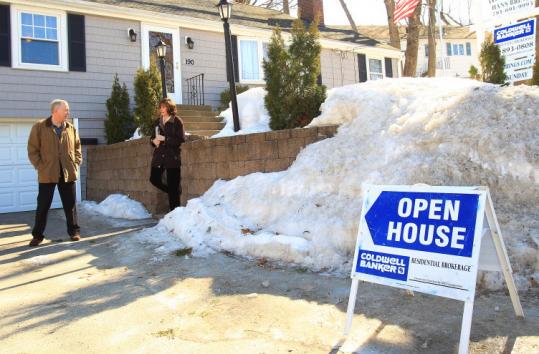
WALTHAM — On a recent sunny, but cold Sunday, Cheryl and Brian Gillespie stood outside a tidy ranch in the Cedarwood neighborhood of this city. They commented on the sound of the traffic coming off Interstate 95. Inside, they pointed out hollow-core doors that needed replacing. They noted gaps and discoloration in the hardwood floors. And then they walked away.
The Gillespies, empty nesters hoping to downsize, have spent the past year searching for a new home, looking at an average of 5 to 10 properties a week. They are ready buyers, with good credit, a sizeable down payment, and preapproval for a mortgage. But as open houses follow private showings, which follow open houses, they say they aren’t ready to compromise: They will look until they find the right home at the right price.
“We have a lot of advantages as home buyers,’’ said Brian Gillespie. Added Cheryl: “Maybe that’s what makes us more picky.’’
With the housing market heading into the crucial spring season, the Gillespies’ attitude suggests any improvement is likely to come slowly. Buyers continue to show they are willing to wait out sellers to gain the amenities and prices they want. And with median prices slipping recently, and mortgage rates holding low and steady, buyers like the Gillespies feel little urgency to make a deal.
The couple’s long search also suggests another sign of a slow comeback for the market. They have been disappointed by the scarcity of move-in-ready homes, an indication that many potential sellers are still unwilling to settle for lower prices.
In order for the housing market to begin a solid, sustainable recovery, said Barry Bluestone, an economist at Northeastern University, sellers will have to accept the reality that it will likely take several years for prices to return to prerecession levels. At the same time, buyers will need to feel that they must act quickly to lock in low prices and rates.
When that happens, perhaps in six months or so, said Bluestone, “We could have a market with more homes to buy, and more home sales.’’
The Gillespies began thinking about moving from their three-bedroom home in North Reading when the last of their three children moved out in September. In addition to finding a smaller place they also wanted to cut their commuting time.
Brian, 52, is a software engineer who works in Needham, a commute from North Reading that he describes as “simply lousy.’’ Cheryl, 48, works as a financial administrator at the Massachusetts Institute of Technology in Cambridge. They narrowed their search to Waltham, which would mean less time in the car for both.
The Gillespies are hoping to find a two-bedroom home, far enough away from noisy main roads, but conveniently located for commuting. A garage, and an updated kitchen and bath are must-haves. Their price range: mid-300’s to mid-400’s.
Since they began their search last year, the Gillespies have spent nearly every Sunday — and many weeknights — looking at homes. Attending open houses has become a Sunday ritual. Cheryl Gillespie updates her list of properties daily, often doing drive-bys during the week to get a preview of the home and neighborhood. When open house listings come out just before the weekend, she maps the route they will take on Sunday.
They are considering making an offer on a Waltham home, but are still weighing, location, layout, and potential resale value, while comparing it with other recent sales in the area.
The Gillespies acknowledge that now is a good time to buy. But they haven’t put their North Reading home up for sale yet, and don’t feel any need to pick up their pace.
They are looking forward to spring, when they hope more homes will come on the market. And they’re still convinced that the right house, and the right price, will come along. Until then, they plan to just keep looking.
“I think we’re at the age,’’ said Cheryl Gillespie, “where we just want what we want.’’
Brittany Danielson Boston Globe February 27, 2011
De-clutter and organize your home for peace of mind. Take a minimalist model home approach to staging and your home will sell faster. Get items out of the way to breeze through a home improvement. Clean house for new spring beginning.
You've got plenty of reasons to get rid of stuff taking up space in your home, but what do you do with it all?
Consumer Reports says there are numerous ways to free up space and relieve your home of items you don't need -- cost free and in some cases with a small cash windfall.
Everyone either has or knows someone who has used Ebay.com, Craigslist.com, Half.com and a host of other online stores where you can sell your stuff, but Amazon.com is often overlooked.
Consumer Reports' extensive "How to get rid of practically anything," in its March 2011 issue, surprisingly, also drops the ball.
There are a host of ways to Sell on Amazon.com from individual sellers to those who want to set up their own web site or have Amazon take care of the fulfillment chores.
Home owners are likely to opt for the individual seller account for its ease of use and limited draw backs. Anything you want to sell must be in Amazon's current catalog and available by Universal Product Code (UPC); European Article Number (EAN); International Standard Book Number (ISBN) or Amazon's own Standard Identification Number (ASIN). And the item must be in full working order and not in need of repair.
That just means Amazon is more suited for relatively newer items, but newer can be relative. Some items can be as old as 10 years or more. If Amazon lists it, and your item is in working order, you can sell it -- books, computers, video games, video game consoles, video recorders and players, stereos, televisions, CDs, DVDs, tools and a whole lot more.
Amazon takes a small cut, but sellers get a shipping allowance for each item sold and the allowance often covers your shipping costs and, in some cases, some of Amazon's cut. The cost to ship larger items can wipe out the shipping allowance and eat into your sales price. That means Amazon is better suited for items that can be shipped at a cost covered by the allowance and any part of your sales price you don't mind giving up to help cover shipping.
Otherwise, here's Consumer Reports' tips for moving out some of those larger items that really gobble space.
• Appliances - Retailers typically haul away the old model when you buy a new one and some local utilities will pay you to dispose of outdated appliances. Some retailers and utilities participate in the Environmental Protection Agency's Responsible Appliance Disposal Program to make sure recycling is adequate.
Check with the Steel Recycling Institute to find your local appliance-recycling program. Also, for an income deduction, donate working appliances to charity -- Habitat for Humanity, Goodwill, Salvation Army, etc.
• Furniture - The Web page for your area on Craigslist or the Bay can get you some cash for furniture that can be delivered and picked up locally. Include photos to help buyers see what you've got.
Donate usable furniture without broken parts to charity or plop it curb side with a "free" sign. For a fee, 1-800-Got-Junk , Waste Management's TheBagster.com and other services will haul away your junk.
• Mattresses - Keep your mattress out of the landfill. As with appliances, retailers will haul away your old mattress when you buy a new one, but they don't all dismantle and recycle them. Check for local recyclers or search Earth911.com for one.
Homeless shelters also make a good second home for mattresses in good condition. Also search Earth911 to determine where you can recycle building materials and electronics.
• Electronics - In addition to Amazon.com, Craigslist and Ebay.com check in with EcoSquid.com for resale and recycling options for all kinds of gear including cell phones, CDs, DVDs, cables, batteries, even inkjet cartridges and the like.
Your city or county, DigitalTips.org and Call2Recycle.or can help you find local recycling centers for electronics.
Before you unload anything like a hard drive, cell phone or other device with identifying information, wipe it clean, digitally. Check with the manufacturer to determine how to remove all traces of your personal information including email, Web visits and other digital trails someone could trace to steal your identification.
Broderick Perkins Realty Times February 24, 2011
Qualifying and being approved for a mortgage are only part of the financial responsibility of buying a home. There's also a host of closing costs that, as a buyer, you should expect. Affordability is a topic on the minds of today's buyers, so researching each of the following costs, large and small, is important.
1. Down Payment. This amount ranges widely depending on the dollar price of your home, but many financial experts recommend a down payment be at least 20 percent of the total cost of the house.
2. Credit Report and Score: Before you even think about buying a home, you need to verify the accuracy of your credit report and score. You may access your credit report three times a year for free at myannualcreditreport.com, but you generally must pay to view your credit score. This costs around $10 - $20.
3. Home inspection: It is imperative that you get a home inspection. Even newer homes may have hidden budget busters, such as termites, mold, or shoddy electrical work. Chances are your offer, unless you are buying "as is", has a clause that allows you to back out of the deal if the home inspection comes back unfavorably. A home inspection takes a few hours, during which you should be present, and costs around $300 to $500.
4. Loan Origination and Points: You may have agreed to pay "points" in order to get a lower interest rate. Think of this as pre-paid interest. For each point purchased, the loan rate is typically reduced by 1/8%. An origination fee is what you must pay the lender to write and process your loan. This can be up to several thousand dollars.
5. Appraisal: An appraisal protects your lender from investing in a property that is over-priced. That means if the home appraises for $200,000, but the seller wants $225,000 ... you will only be able to get financing for $200,000. An appraisal also helps you to know the real market value of the home you are interested in.
6. Private mortgage Insurance: According to the Federal Reserve Bank of San Francisco, "PMI is extra insurance that lenders require from most homebuyers who obtain loans that are more than 80 percent of their new home's value. In other words, buyers with less than a 20 percent down payment are normally required to pay PMI." PMI protects your lender if you default on a loan, something that weighs heavily on the minds of lenders in today's economic climate.
7. Notary fees. Some states have a cap on the amount a notary may charge, while others don't. But you should generally expect a fee less than $10.
The good news? Your lender and real estate agent will provide a "good-faith estimate" of your expected settlement costs. Planning ahead for these expenses is important, and it is another reason to examine whether or not you can truly afford to buy a home at this time.
Carla Hill Realty Times February 24, 2011
After slight movement early last week, mortgage rates ended up looking better for borrowers with a decrease of .125% for conforming 30 year and 15 year mortgage interest rates making them more competitive with FHA mortgage rates.
FreeRateUpdate.com's daily survey of wholesale and direct lenders show that current 30 year fixed mortgage rates are at 4.750% and 15 year fixed mortgage rates are at 4.125%. 5/1 adjustable mortgage rates are at 3.250%. Still remaining below 5%, these are the best mortgage rates available with 0.7 to 1% origination fee to well qualified borrowers who can also meet lender approval.
FHA 5/1 adjustable mortgage rates increased .125% and are at 3.625%. >FHA 30 year fixed mortgage interest rates are at 4.625% and FHA 15 year fixed mortgage interest rates are at 4.000%, both remaining the same.
FHA mortgage loans continue to attract borrowers for the benefits they offer such as the low down payment requirement although FHA closing costs (APR) are higher due to the upfront mortgage insurance premium and other applicable FHA fees. Coming April 18th, FHA is increasing the annual mortgage insurance premium by .25% for FHA 30 year and FHA 15 year fixed rate mortgage loans.
Jumbo 15 year fixed mortgage rates saw the biggest jump increasing .250% and are at 5.250%. Jumbo 30 year fixed mortgage rates are at 5.500% and jumbo 5/1 ARM loan rates are at 4.125%, both remaining the same. Jumbo mortgage loans are available for borrowers in need of financing above the conforming loan limit which is $417,000 to $729,250 depending on location. Available with 0.7 to 1% origination fee, these low jumbo mortgage rates can still be obtained by borrowers who have outstanding credit.
MBS prices (mortgage backed securities) have fluctuated each day this past week depending on the news and investor reaction. Mortgage rates increase and decrease in the opposite direction of MBS prices. After Tuesday's mixed results, mortgage rates stabilized for the rest of the week upon the release of the producer price index,, the consumer price index and housing starts which all came in better than expected.
FreeRateUpdate.com surveys more than two dozen wholesale and direct lenders' rate sheets to determine the most accurate mortgage rates available to well qualified consumers at a standard .07 to 1 point origination.
Ed Ferrara Realty Times, February 24, 2011
WASHINGTON — Sales of US previously owned homes unexpectedly climbed in January to the highest level in eight months as investors used all-cash transactions to snap up distressed properties.
Purchases increased 2.7 percent to a 5.36 million annual rate, figures from the National Association of Realtors show. The share represented by foreclosures and short sales rose to a 12-month high, pushing the median price to the lowest level in almost nine years.
Affluent investors may continue taking a bigger share of the market as credit restrictions and 9 percent unemployment keep first-time buyers at bay. A pickup in job growth is needed to ensure more Americans will be in a position to consider home ownership.
“It is really a foreclosure-driven market,’’ said Ethan Harris, head of developed markets at Bank of America Merrill Lynch Global Research, who projected sales would increase to a 5.38 million rate. “I don’t think it is a sign of the market returning to health.’’
Lawrence Yun, chief economist at the realtors’ group, said distressed sales accounted for 37 percent of total sales last month and all-cash transactions represented 32 percent, three times the average of about 10 percent.
The increase in demand was “encouraging,’’ Yun said in a news conference as the figures were being released yesterday. “Right now it is the cleansing of distressed property that is coming on to the market’’ that is driving sales.
Investors with all-cash offers are rushing in looking for “bargains,’’ he said.
Those sales climbed to about 50 percent of the total in cities like Las Vegas and Miami last month, he said. The share of first-time buyers fell to 29 percent last month compared with an average 40 percent, said Yun.
The median price decreased 3.7 percent from January 2010 to $158,800, the lowest since April 2002. Purchases were up 5.3 percent from a year earlier, when a government tax break was still in effect.
The number of previously owned homes on the market fell 5.1 percent to 3.38 million in January. At the current sales pace, it would take 7.6 months to sell those houses compared with 8.2 at the end of the prior month.
“I think 2011 will be a marginal, weak year in the homebuilding industry,’’ said D.R. Horton Inc.’s chief executive, Donald Tomnitz
Bob Willis Bloomberg News / February 24, 2011