In Mass., home purchases fall 19%, condo deals 23%
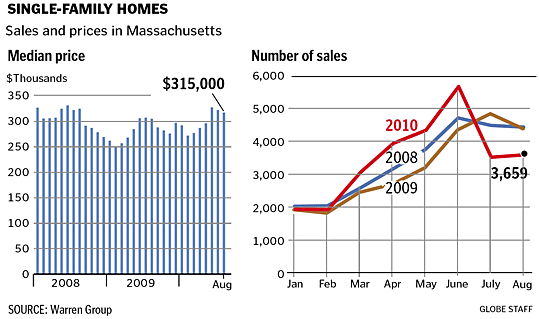
It was the worst August in more than two decades for Massachusetts home sales as the state’s housing market continued to adjust to the end of the federal tax credit for home buyers, a Boston real estate tracking firm reported yesterday.
Tweet Be the first to Tweet this!Yahoo! Buzz ShareThis Sales of single-family homes fell nearly 19 percent from a year earlier, while condominium sales dropped 23 percent — the second consecutive month of steep year-over-year declines, according to Warren Group. It was the lowest level of August sales since the firm began tracking such data in 1987.
The Massachusetts Association of Realtors, which follows a slightly narrower swatch of the housing market, reported similar declines.
The decline in sales was expected, given the surge in previous months as buyers rushed to take advantage of an expiring federal tax credit of up to $8,000. With the distortions caused by the tax credit, analysts said, it is unclear where the local housing market is heading.
But rising prices suggest housing has at least stabilized. Both Warren and the realtors group recorded increases — about 4 and 5 percent, respectively — from August 2009, pushing the median price of a single-family home above $300,000.
A different measure of home prices, the widely respected Standard & Poor’s/Case-Shiller index, showed Boston-area prices climbed nearly 3 percent in July from a year earlier.
“We’re bouncing along the bottom,’’ said Karl Case, economics professor emeritus at Wellesley College and co-creator of the index. “As long as the economy continues to get better, and the Fed keeps interest rates low, the housing market will pick up.’’
Economists are scrutinizing the housing market to see if it can recover without federal stimulus programs. Home sales in both the state and nation fell sharply in July, after most of the sales supported by the tax credit had closed.
Jamaica Plain couple find DIY limits and the benefits of pros in condo renovation
Julie and Todd Williams knew they would have their hands full with the condominium they purchased in Jamaica Plain several years ago. It had a long hallway that Julie Williams likened to a bowling alley. The kitchen floor was covered in laminate tiles. And much of the place bore the idiosyncratic imprint of the previous owner, like kitchen countertops with a boomerang pattern and the flock of birds stenciled over the bathroom walls and shower curtains.
But the couple wanted a place they could make their own. And though they didn’t consider themselves particularly handy, they were willing to use elbow grease.
It was then the Williams learned the limits of their do-it-yourself skills: While changing a light fixture, they learned the condo lacked some internal wiring; a circuit box did not have a protective cover.
“The electrician said if there was a short in the family room, the entire home could have gone up in flames,’’ Julie Williams said. “Taking one step forward would be like taking 30 steps back.’’
Since then, the Williams have taken many steps forward with the renovation of their condo — and not all of them by themselves. They discovered what they could handle themselves, and when it was time to call in the professionals. Other homeowners, beguiled by the home renovation shows on cable television or instructional videos on the Internet, would do well to learn from the Williams’ experience and not hesitate to call in specialists when the job risks getting out of hand.
“Often people call us in after the fact, after they’re in over their heads,’’ said Michael Battista, the owner of R&R Battista Services, a building company in Watertown. “People think they’re going to be saving money, but it ends up costing more because we’ve got to buy new stuff.’’
And often it’s the new homeowner who ends up bearing the expense of shoddy work done under the previous owner.
Case in point. Earlier this month, the owners of a Sudbury home wanted to replace a washer and dryer in the bathroom with a tub. “When we went in to give prices, we discover there’s no venting. That’s what takes out the methane gas,’’ Battista said. “It should have cost no more than $3,000. Now we’re talking about up to $10,000.’’
What good are ultralow mortgage rates if you can’t plow through the blizzard of paperwork required to get a loan?
Falling prices and mortgage rates in the mid 4-percent range have made home ownership more affordable for many house hunters. But backlogs in the mortgage process, tighter lending requirements, and appraisals that don’t support the proposed sale prices are some of the obstacles making it difficult for many buyers to close a deal.
It’s not impossible — just more difficult. Patience and paperwork, lenders and economists advise, will help get the frustrated buyer through the process. Be prepared to produce an array of documents, though, often multiple times.
“We are living in a fully documented world at this point,’’ said Michael Fratantoni, vice president of research economics at the Washington-based Mortgage Bankers Association. “It is burdensome right now, but I think it is necessary.’’
Lenders, appraisers, and underwriters are all more conservative in response to the freewheeling days of 2005 and 2006, when many mortgages were doled out without any proof of assets or income.
Here are some things to think about when applying for a loan:
Rate lock It is taking much longer to close a mortgage — 60 days or more — because of an influx of loan applications, said Cameron Findlay, chief economist for the online mortgage exchange LendingTree.com. Because of the risk the longer approval period could cost you a good interest rate, Findlay recommends talking to lenders so you clearly understand their policies and getting a commitment letter in writing. Consider asking for a 45-day lock at the same rate as what the lender offers on a 30-day lock.
“Borrowers should make sure expectations regarding the processing of their loan are clearly identified so they don’t risk losing their locked interest rate,’’ Findlay said.
Appraisals Whether it’s for a purchase loan or refinancing, a low appraisal can kill a deal. And the risk of that happening is greater now since the subprime mortgage meltdown and the housing market crash. Appraisers are being pushed to be more conservative, prices are soft, and comparative properties hard to come by, said Stephen Sousa, executive vice president of the Massachusetts Board of Real Estate Appraisers.
Say they’ll move fast to implement new financial law
WASHINGTON — The Obama administration is promising to move quickly to simplify the paperwork consumers receive when taking out a mortgage.
Obama adviser Elizabeth Warren and Treasury Secretary Timothy Geithner said yesterday that the administration was committed to implementing, as soon as possible, several consumer protections that are part of the financial system overhaul that Congress passed in the summer.
Geithner and Warren made the comments as part of a forum they held at the Treasury Department with a number of consumer advocacy groups, financial literacy counselors, and representatives of the mortgage industry to receive input on ways to simplify mortgage disclosure forms.
“Whenever possible, we are committed to expediting completion of the law’s requirements ahead of statutory deadlines,’’ Geithner said. “Moving quickly to improve mortgage disclosures is one in a series of concrete steps we’re taking.’’
One of the requirements of the Dodd-Frank law is to combine and simplify two overlapping mortgage disclosure forms, one required by the Department of Housing and Urban Development and the other by the Federal Reserve.
Despite a decade of efforts, the government has yet to combine the two forms.
Warren said that streamlining the disclosure process would give families better tools to make better choices when choosing financial products.
“This is particularly true in the mortgage market, where borrowers receive stacks of incomprehensible paperwork when they’re looking for a loan,’’ she said. “Fine print obscures the cost of credit and makes it impossible for families to compare products.’’
The Treasury forum was the first event Warren has held since being selected by President Obama last Friday to serve as the overseer of the effort to set up the Consumer Financial Protection Bureau created by the new law.
Facing the prospect of a likely Senate filibuster, Obama decided against nominating Warren, a Harvard law professor, to head the new agency. Instead, he chose to name her as a special adviser to the White House and to the Treasury in charge of leading the effort to set up the new bureau. In that job, she will not require Senate confirmation.
In an appearance yesterday on CBS’s “The Early Show,’’ Warren said that she would not back down in the face of business resistance to her appointment.
Warren said that Obama told her not to worry about job titles, but to “start pushing back’’ against companies fighting new regulations aimed at protecting borrowers.
She said, “That’s exactly what I intend to do, and I intend to do it as hard as I can.’’
Martin Crutsinger Associated Press September 22, 2010